Local SEO has never been just about putting a city name next to a service keyword.
A customer searching for a nearby business may compare websites, reviews, business profiles, service information and answers to specific questions before deciding who to contact. At the same time, search itself is becoming more conversational. People can now ask detailed questions through AI-powered search experiences instead of relying only on short keyword phrases.
That creates a new challenge for small businesses.
They need to be discoverable in traditional search while also making their business information easy for modern search systems to understand. For a small team already managing customers and daily operations, keeping up with all of this can be difficult.
This is where artificial intelligence can help.
AI does not replace local SEO. Instead, it can make research, analysis, content planning, monitoring, and repetitive tasks more efficient. When combined with real business expertise, it gives small companies another way to understand what customers are looking for and where their online presence can improve.
How AI Is Changing the Way Customers Find Local Businesses
The biggest change is not simply that businesses have access to new SEO software. Search behavior itself is becoming more conversational.
A traditional search might be something like emergency electrician near me. A customer using an AI-powered search experience could ask a much more detailed question, such as which local electrician handles emergency work, serves a particular area and has experience with a specific problem.
The underlying need is the same, but the way the question is expressed is different.
Modern search systems are increasingly capable of interpreting context, intent, relationships between topics, and the meaning behind a question. This makes it important for local businesses to explain their services clearly rather than relying on repetitive keyword placement.
For small businesses, this creates an opportunity.
A company with genuinely useful service information, clear business details, customer-focused answers, and evidence of real experience gives search systems more meaningful information to understand.
This is an important part of AI search optimization for local businesses. The objective is not to write for an algorithm. It is to make the business easier to understand for both customers and the systems helping them discover information.
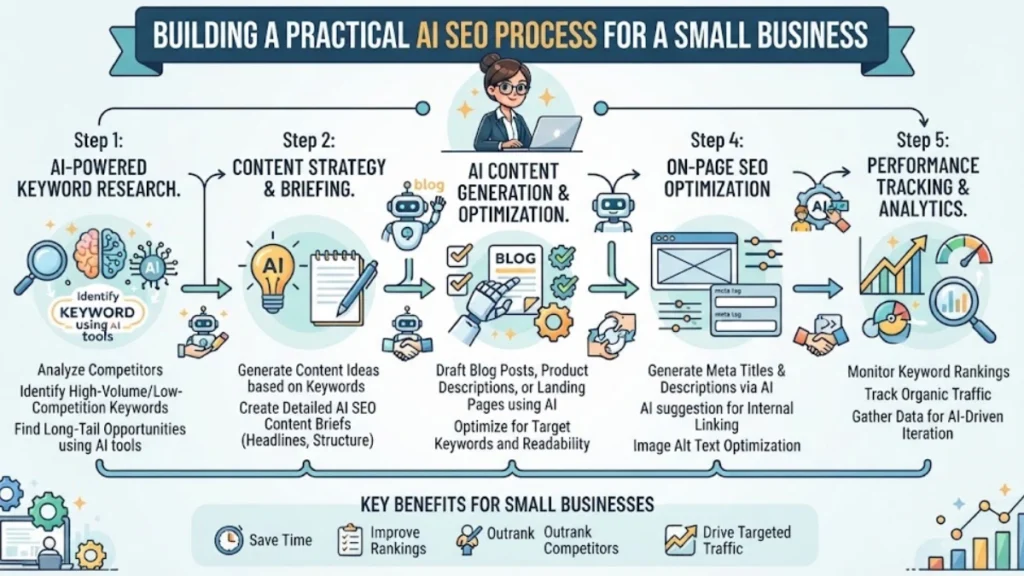
Where AI Can Make Local SEO Easier for Small Businesses
One of AI’s strongest advantages is its ability to process information quickly.
A local SEO campaign can involve large amounts of search data, website content, reviews, competitor information and business listings. Manually examining everything can consume valuable time.
AI can help organize that information so an SEO professional or business owner can concentrate on the decisions that matter.
Smarter keyword and search-intent research
Instead of looking at keywords as isolated phrases, AI can group searches according to the problem behind them.
For example, a home services company might discover different groups of searches related to emergency repairs, routine maintenance, replacement services, pricing questions and specific problems.
That distinction helps determine what deserves a service page, what belongs in an FAQ and what could become a useful educational article.
The result is a more logical website rather than a collection of pages created around minor keyword variations.
Faster content gap analysis
AI can review existing content and identify areas where important customer questions have not been addressed.
That can be useful when an established website has good services but outdated or incomplete explanations.
Rather than producing another generic article, the business can improve the pages that already have commercial value.
Better understanding of customer feedback
Reviews contain more information than star ratings.
Customers often mention what they liked, what confused them, why they chose a company, and where the experience could have been better. AI-assisted sentiment analysis can organize recurring themes across large numbers of reviews.
Those findings can influence website messaging, FAQs, service descriptions, and customer experience improvements.
More efficient local information management
Business information needs to remain accurate wherever customers encounter it.
AI-supported workflows can help identify inconsistencies in business names, addresses, phone numbers, opening hours, services, and other listing information. The technology can make the checking process faster, although important changes should still be reviewed before publication.
This is one practical application of local SEO automation: reducing repetitive checking without handing the entire process over to a machine.
AI Can Improve Local Content Without Replacing the Business’s Expertise
One of the biggest mistakes a small business can make with AI is assuming that more automatically generated content means better SEO.
A page about a local service becomes valuable because it contains useful information that customers can trust. AI can help structure that information, but the business needs to provide the substance.
For example, an experienced contractor knows which problems customers commonly face, what preparation is required, what mistakes people make, and when professional assistance is appropriate. Those details provide genuine experience that a generic AI-generated article cannot invent.
That is why AI content optimization for small businesses should focus on improving useful information rather than mass-producing pages.
AI can help identify unclear sections, suggest questions to answer, improve organization, and make complicated explanations easier to read. The final content should still be checked by someone who understands the business.
This approach also supports E-E-A-T.
Experience comes from real work and customer interactions. Expertise comes from knowing the service. Authoritativeness develops through reputation and credible information. Trustworthiness comes from accuracy, transparency, and consistency.
AI can help communicate those qualities. It cannot manufacture them.
Local Listings, Reviews, and Reputation Still Matter
A website is only one part of local visibility.
Customers may encounter a business through a map result, directory, review platform, social profile, or another website before visiting the company’s own site. That makes consistency and reputation important parts of the broader local search picture.
AI can support this work by helping businesses identify patterns and prioritize problems.
For example, if customers repeatedly mention difficulty reaching a business, slow responses, or confusion about a service, that information may reveal a genuine operational issue rather than merely an SEO problem.
Likewise, positive feedback can show which aspects of a company’s service customers value most. Those insights can help shape website messaging without turning testimonials into exaggerated marketing claims.
The important distinction is that AI should help interpret feedback, not manufacture it.
Businesses still need authentic reviews from real customers and accurate information across their online presence.
Preparing for AI-Powered Search Without Abandoning Traditional SEO
There is a lot of discussion about the future of search, particularly as AI-generated answers and conversational search experiences become more common.
But small businesses do not need to choose between traditional SEO and AI search.
The fundamentals still matter.
A search system needs to understand what a business does, where it operates, which services it provides, and why its information deserves to be trusted. A clear website, useful content, accurate business information, strong reputation, and sensible site structure all contribute to that understanding.
What is changing is the way customers may interact with that information.
Search is increasingly moving toward questions, context, and complete conversations. This makes natural explanations more valuable than pages built around awkward keyword repetition.
For example, instead of creating separate pages for every minor variation of “plumber in [location],” a business may be better served by developing strong service pages, useful local information, practical FAQs, and supporting educational content.
This is also where AI and the future of SEO intersect. AI can help businesses understand emerging search patterns, but the underlying goal remains the same: provide information that genuinely helps someone make a decision.
What AI Cannot Replace in Local SEO
AI is useful, but it should not become the strategy.
A tool may identify a keyword opportunity, but it cannot automatically know whether that service is profitable for the business. It may suggest a location page, but that does not mean the page deserves to exist. It can produce an answer, but that answer may still need fact-checking.
Human judgment becomes especially important when local competition is strong.
A Google local SEO expert can look beyond individual recommendations and evaluate the relationship between the website, business profile, services, reputation, competitors, content, and commercial objectives.
This is also why businesses should be careful when evaluating claims about AI SEO. No software can legitimately promise a particular Google Maps position, guaranteed rankings, instant traffic, or guaranteed leads.
The better question is:
Can this technology help us make better SEO decisions and execute them more efficiently?
In many cases, the answer is yes.
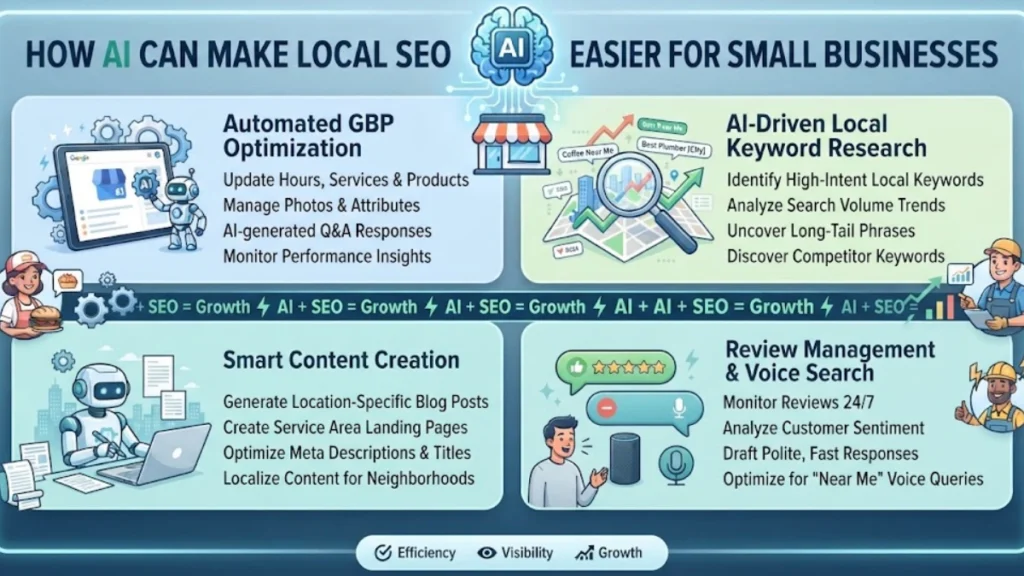
Building a Practical AI SEO Process for a Small Business
The right approach does not require a business owner to automate everything at once.
Start with the areas where manual work is taking the most time or where useful information is difficult to organize.
A practical workflow might involve:
- Researching local searches and grouping them by intent.
- Reviewing existing service pages for missing information.
- Analyzing customer questions and review themes.
- Identifying content gaps and internal-link opportunities.
- Checking important business information for inconsistencies.
- Using AI to assist with reporting and prioritization.
- Having a human review important recommendations before implementation.
The technology becomes much more useful when every task has a purpose.
For example, discovering that customers frequently ask about emergency availability should lead to a useful answer on the website. Finding that several reviews praise a particular service may reveal a genuine strength worth explaining. Identifying a weak service page should lead to improving that page rather than automatically creating five new ones.
That is the difference between using AI as a marketing shortcut and using it as a decision-support tool.