Selling SEO to a local business is less about convincing an owner that SEO is important and more about showing them where their business is losing opportunities in search.
A roofing company, dental practice, concrete contractor, HVAC business, or medical clinic can all have websites and still struggle to attract customers through Google. The reason is rarely just bad SEO. The real issue may be poor service targeting, weak local relevance, an unclear website, limited visibility for valuable searches, or competitors doing a better job of answering customer needs.
That gives SEO professionals a better sales opportunity.
Instead of starting with a package or a list of technical tasks, start with the business itself. Understand how it makes money, who its customers are, which services matter most and where potential buyers are discovering competitors.
When the SEO recommendation is built around those answers, selling becomes a consultation rather than a pitch.
Understand What Makes a Local SEO Prospect Valuable
The first step is not contacting as many businesses as possible. It is identifying companies where improved search visibility could realistically support business growth.
A useful prospect has more than a website and a Google Business Profile. It has services that people actively search for, a defined market and enough commercial value behind each customer to justify investing in marketing.
Consider two businesses.
One receives most of its work from existing customers and has little capacity for additional jobs. The other has strong services, available capacity and competitors consistently appearing ahead of it for valuable local searches.
The second business presents a much stronger SEO opportunity.
This is why prospect research should begin with commercial questions. What does the company sell? Which service generates the most value? Where does it operate? Is demand seasonal? Does one new customer represent a meaningful amount of revenue?
You can then investigate the search landscape around those services.
Look at the pages appearing for relevant local queries, the quality of competing websites, the strength of their local presence and whether the prospect has useful pages addressing the same customer needs.
The goal is not to tell every business that it needs SEO. The goal is to identify where SEO has a credible business case.
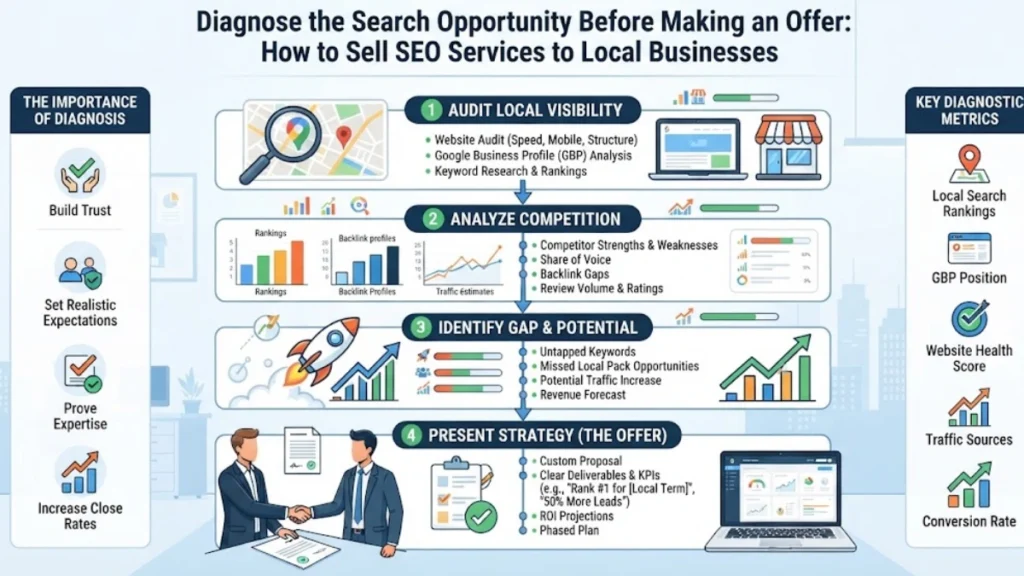
Diagnose the Search Opportunity Before Making an Offer
A generic SEO pitch sounds the same to almost every owner.
A diagnosis does not.
Suppose an HVAC company has a polished homepage but very little useful information about individual services. Its competitors have dedicated pages for heating repair, air conditioning installation, emergency service and other commercially relevant topics.
That observation creates a much more meaningful conversation than saying, Your website needs more content.
For a concrete contractor, the opportunity might look completely different. Search demand may be divided between different types of concrete work and several service locations. In that situation, local SEO for concrete services may require a stronger relationship between service pages, geographic relevance, and customer questions.
A dental practice has another set of priorities. Treatment information, location relevance, patient trust, and appointment-focused website experiences may matter more than simply producing large amounts of blog content.
This is where an SEO professional can demonstrate expertise.
Instead of presenting a long audit full of technical terminology, explain the gap between what the business offers and what customers can easily find online.
A useful diagnosis should answer:
- Which commercially important searches are relevant to the business?
- Where is the company currently visible?
- What competing businesses are capturing attention?
- Which website or local-search weaknesses are worth addressing first?
- What customer action should the improved visibility support?
That information gives the prospect a reason to continue the conversation.
Match the SEO Strategy to the Business Model
There is no universal local SEO package that makes equal sense for every company.
A service-area contractor may need a different strategy from a dental office with one established location. A healthcare organization may require a more careful approach to content quality and trust. An HVAC company may have strong seasonal demand that changes which services deserve attention throughout the year.
For home-service businesses, the strategy should reflect how people actually hire providers. This is where local SEO strategies for home service providers can include service-specific optimization, location relevance, useful customer resources, and improvements to the journey from search to inquiry.
For companies operating across several communities, a local SEO agency for home services should also understand the difference between having a service area and creating genuinely useful local pages. Simply producing dozens of near-identical location pages does not create meaningful value for customers.
A near me SEO strategy should follow the same principle. The objective is not to insert near me into every page. It is to strengthen the signals and content that help a business become relevant when people are looking for nearby services.
The offer becomes easier to sell when the prospect can see that the strategy was designed specifically for their business rather than pulled from a standard template.
Turn SEO Work Into a Clear Business Proposition
Once the opportunity is identified, explain what you would actually do.
Avoid presenting SEO as a mysterious monthly activity. The client should understand the relationship between the work and the problem you identified.
For example, if important services lack strong landing pages, explain how developing useful service content can give customers a clearer destination from search.
If the business information is inconsistent across important platforms, explain why cleaning up that information is worth addressing.
If the website receives visitors but does a poor job of helping them contact the business, SEO alone may not be the complete answer. Website usability and conversion improvements could deserve attention as well.
This is also where specialized offers can make sense.
A company may be interested in a Google local map SEO service because map visibility is central to its customer acquisition. Another may need broader organic optimization. A healthcare organization could require healthcare local SEO services focused on trustworthy information and local discoverability.
The service name matters less than the reasoning behind it.
A strong proposal should tell the prospect:
Here is the opportunity → here is what is preventing it → here is the work I recommend → here is how we will evaluate progress.
That structure feels far more credible than presenting a menu of SEO tasks.
Make Your Sales Conversation About the Customer’s Business
The strongest SEO sales conversations often involve more listening than talking.
An owner can tell you things that a keyword tool cannot.
They may explain that emergency jobs are the most profitable, that one neighborhood produces particularly valuable customers, that certain services are difficult to sell, or that their busiest season begins several months from now.
Those details can change the SEO strategy.
Ask questions that uncover the economics behind the business rather than questions that merely collect marketing information.
For instance, you might ask which services they most want to grow, which areas they currently serve, what type of customer they consider ideal, and what usually causes a prospect to contact them.
Once you understand those answers, SEO becomes easier to explain.
A business owner is more likely to understand the value of a local map SEO service when you can connect it to a specific customer journey rather than simply discussing rankings.
The same applies when discussing best local SEO strategies for service-based businesses. The best strategy is not necessarily the one containing the most activities. It is the one that puts resources behind the searches, pages, locations, and customer actions that matter to that particular business.
Build an Offer That Is Easy to Understand and Evaluate
Complex pricing can make a good SEO strategy difficult to buy.
Your proposal should make the scope obvious without reducing the service to a checklist.
One option is to begin with a defined strategic project that identifies the major opportunities and establishes priorities. From there, ongoing work can be based on the actual needs discovered during implementation.
Another approach is to organize monthly services around clear areas of responsibility, such as technical improvements, local optimization, content development, authority building, and performance analysis.
The important point is that each component should have a reason for being included.
For example, content strategy services for local SEO should not mean publishing a predetermined number of articles every month. Content should answer real customer questions, support important services, strengthen topical relevance, and contribute to the broader website structure.
Likewise, a hyper local SEO services strategy should focus on genuine local usefulness rather than producing repetitive pages for every nearby place.
Pricing conversations should also be grounded in economics. You do not need to promise a specific number of leads. Instead, help the business understand what a new customer is worth, how many additional customers would make an investment meaningful, and which measurements can be monitored during the engagement.
That creates a realistic commercial conversation without making unsupported promises.
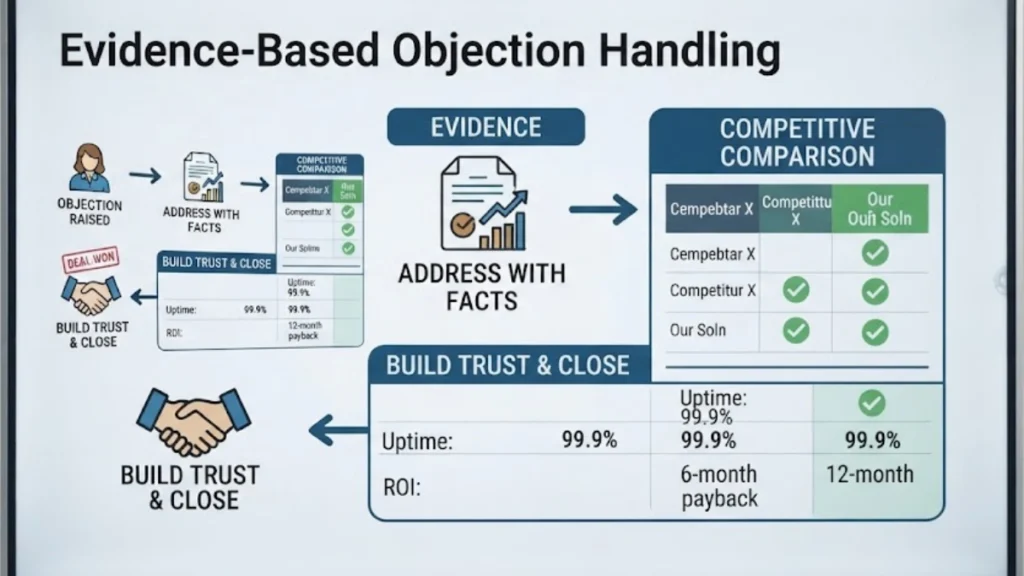
Handle Competition and Objections With Evidence
Some prospects will say they already have an SEO provider. Others will say they tried SEO and saw little value. Some will simply want the cheapest option.
The wrong response is to attack another agency or promise dramatically better rankings.
A better response is to return to evidence.
If the business already works with an SEO company, identify what is working and where there may still be opportunities. If they previously had a poor experience, ask what was promised, what was delivered, and how progress was measured.
If price is the main objection, clarify the scope rather than immediately discounting the service.
This approach helps establish the difference between a professional SEO engagement and a commodity service.
A company searching for the best lead generation services for local SEO should be encouraged to examine how leads are defined, tracked, qualified, and connected to actual business outcomes.
Likewise, someone looking for local search experts should evaluate whether the provider understands their industry and market instead of choosing an agency solely because it promises first-page rankings.
Professional credibility comes from transparency.
Never promise guaranteed rankings, guaranteed Google Maps positions, instant traffic, or a fixed number of leads. Search visibility depends on factors that no SEO provider completely controls.
Build Long-Term Value After the Sale
Winning the client is only the beginning.
Local SEO works best when the strategy can evolve as new information becomes available. Search behavior changes, competitors improve their websites, businesses introduce new services, and customer priorities shift.
That means reporting should be more useful than a monthly list of ranking positions.
Explain what was changed, what was learned, what deserves attention next, and how the work relates to the client’s business objectives.
For a home-service company, that might mean examining visibility around priority services and locations. For a dental practice, it could involve understanding how treatment pages perform in attracting relevant visitors. For a healthcare organization, the focus may include the usefulness and discoverability of important patient-facing content.
This ongoing process also creates opportunities to expand the relationship responsibly.
A client may initially need local optimization and later benefit from additional content development, website improvements, or conversion-focused work. Those recommendations should emerge from evidence rather than being added simply to increase the monthly invoice.
That is what makes selling SEO services to local businesses sustainable. The client should continually understand what you are doing, why it matters, and what the next logical improvement is.