Small businesses often compete with larger companies that have bigger marketing teams, stronger content budgets and established websites.
At the same time, customers are changing how they search, using detailed questions, conversational queries, local searches, and AI-powered search experiences to research products and services.
Tools such as Surfer SEO can support content optimization, Semrush can assist with keyword and competitor research, while Rank Locale can help with local map visibility and AI review management.
AI SEO helps small businesses save time with research, content planning, competitor analysis, and SEO tracking.
AI can find opportunities quickly, but human expertise still matters. The best approach combines AI with useful content, accurate information, strong SEO and a clear understanding of customers.
What AI SEO Means for Small Businesses
AI SEO refers to using artificial intelligence to support different parts of search engine optimization.
Depending on the platform or provider, this may include search-intent research, keyword analysis, competitor research, content planning, technical audits, internal-link analysis, content optimization, and visibility monitoring.
AI search engine optimization services can accelerate research and repetitive tasks, but human judgment is still needed to understand whether an opportunity is relevant, commercially valuable, accurate, and appropriate for the brand.
A small business does not need to automate every SEO task. It needs to automate the tasks where technology can save time while keeping important decisions under professional control.
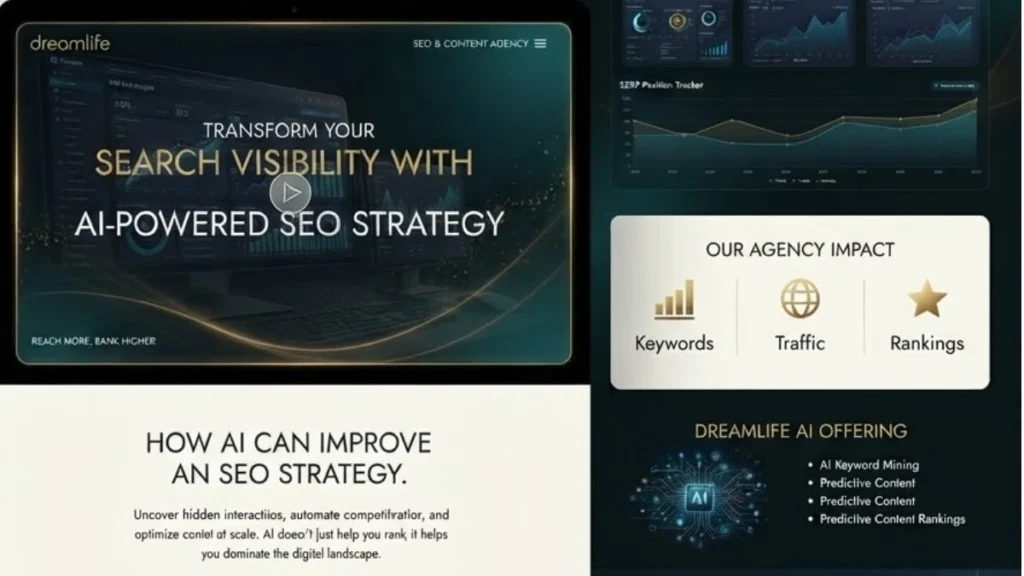
Where AI Can Improve an SEO Strategy
AI can support several areas that traditionally require significant manual research. This can be especially useful for small businesses with limited marketing resources.
- Search-intent research: AI can organize searches around informational, commercial, transactional, and local intent.
- Content gap analysis: Businesses can compare their website with competitors to identify useful topics they currently do not cover.
- Technical SEO analysis: AI-assisted tools can help identify potential issues involving indexing, internal links, site structure, metadata, and page organization.
- Content planning: Related subjects can be grouped into logical topic clusters rather than treated as unrelated keywords.
- Performance analysis: Large amounts of search data can be reviewed to identify trends and areas that deserve further attention.
An auto SEO service can automate portions of this work, but businesses should understand exactly what is being automated. Automatically creating pages, changing important website elements, or publishing unreviewed content can create quality problems.
A better workflow is to use AI for research and recommendations, then apply human review before important changes are made.
AI Search Is Changing How Businesses Need to Be Visible
Traditional keyword rankings remain important, but search visibility is becoming broader. Customers may encounter a business through standard results, local listings, featured information, maps, or AI-generated answers.
That means a website should provide information that is easy for both people and search systems to understand.
How to Improve Visibility in Google AI Overviews
There is no guaranteed method for appearing in Google AI Overviews. Businesses should be cautious of providers promising automatic inclusion or immediate results.
A more realistic strategy is to strengthen the quality of the information already available on the website.
Service pages should clearly explain what the business offers, who the service is intended for, and what customers should know before contacting the company.
What Is SEO Intelligence?
A major advantage of AI-assisted SEO is the ability to turn large amounts of information into actionable insights.
In practical terms, SEO intelligence means using search, competitor, website, content, and performance data to make better optimization decisions.
Instead of asking only whether a keyword ranks, businesses can examine why a page is performing.
For example, a local service company might discover that competitors receive visibility for several questions surrounding a major service, while its own website only has a basic service page.
The answer is not necessarily to publish dozens of articles. Some questions may deserve additional sections on the service page. Others may work better as guides or FAQs. The important decision is determining which information genuinely helps customers.
Build Topic Depth Instead of Random Content
A stronger strategy builds depth around the services that matter most to the business. A plumbing company.
For example, could create a central plumbing service page supported by useful resources covering common problems, repair considerations, maintenance, service expectations, and customer questions.
This is particularly relevant for businesses searching for AI SEO near me. Finding a nearby provider may be convenient, but location should not be the deciding factor.
Choosing AI SEO Tools and Professional Services
The AI SEO market includes tools for research, content optimization, technical analysis, automated workflows, and AI-search monitoring. Not every small business needs all of them.
If a website has technical issues, those should be addressed before producing large amounts of new content. If the site has useful services but weak topical coverage, content research may be more valuable.
If traditional SEO is established and the business wants to understand emerging AI-search visibility, specialized monitoring may make sense. When comparing top AI SEO agencies, businesses should look beyond the word AI.
Ask how the provider researches the business, validates recommendations, handles content quality, measures progress, and connects SEO activity to commercial objectives.
Search performance depends on competition, website quality, authority, content relevance, technical health, search demand, and the quality of implementation.
Measuring AI SEO Performance
Businesses can monitor organic impressions, relevant search visibility, qualified website traffic, service-page engagement, calls, forms, inquiries, and lead quality. These measurements provide a clearer picture of whether SEO is contributing to business growth.
For AI search, businesses can also monitor brand mentions, relevant search prompts, competitor visibility, and changes in how their information appears across emerging search experiences.
A best AI mode SEO rank tracker can help organize visibility data, but tracking alone does not improve SEO. It simply provides information that can guide decisions.
The most valuable measurement connects search performance with business outcomes.
A page that attracts fewer visitors but generates qualified inquiries may be more valuable than an article receiving significant traffic without producing meaningful engagement.
When to Hire an AI SEO Specialist
AI tools can help businesses manage parts of SEO internally, but professional support becomes useful when the website, market, or strategy becomes more complicated.
An AI SEO specialist can help interpret search data, prioritize opportunities, coordinate content and technical work, and ensure AI-assisted recommendations are appropriate for the business.
Professional assistance may be particularly useful for businesses facing strong competition, multiple services, several locations, technical website issues, or limited internal marketing resources.
Rank Locale approaches AI SEO as part of a broader digital strategy, connecting search optimization with website performance, content, local visibility, and customer acquisition.
The goal is not to use AI simply because it is available. The goal is to determine where AI can make the SEO process more efficient and where professional expertise can create better decisions.