Small businesses are entering a different kind of search environment. Customers still use Google to find nearby companies, compare services, check reviews, and visit websites, but they are also beginning to ask longer, more specific questions through AI-powered search experiences.
That raises an important question for business owners: Does AI actually change what a local business needs to do to get found online?
The answer is more practical than simply adding AI to an SEO strategy.
when search engines and chatbots (like ChatGPT, Perplexity and Google AI Overviews) recommend specific local businesses directly in conversational answers. AI local SEO focuses on getting your business named inside direct AI answers rather than just ranking as a standard blue link
For a small business, the opportunity is to use AI where it provides useful insight while keeping the foundation of local SEO focused on customers, relevance, accuracy and trust.
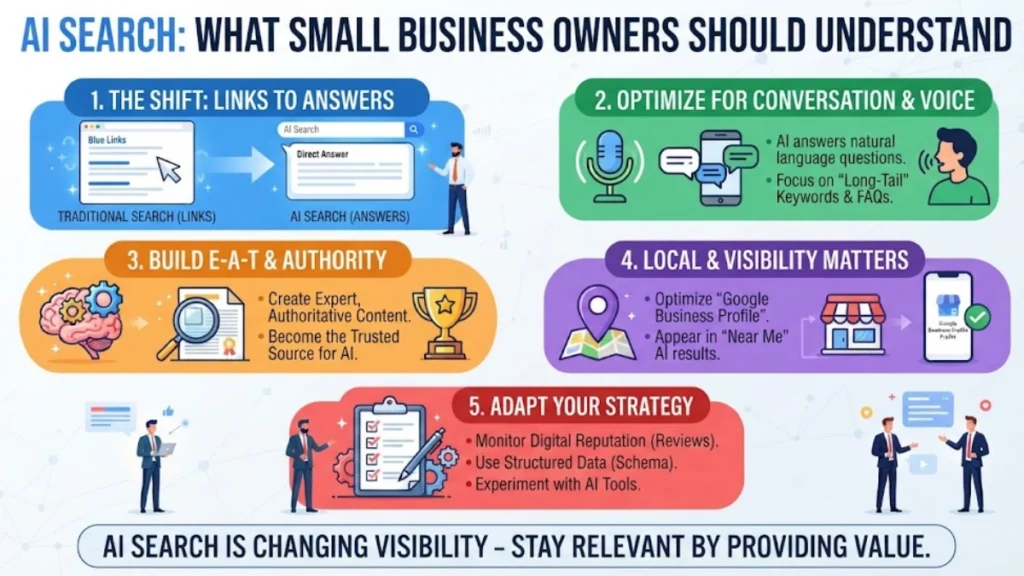
What Small Business Owners Should Understand About AI Search
Traditional search generally gives users a list of results. AI-assisted search can take a more conversational approach by interpreting a detailed question and presenting a summarized response or selection of businesses.
That changes the way a potential customer may research a purchase.
Someone looking for a local electrician might not search only for “electrician near me.” They could ask which electrician serves a particular area, handles a certain type of electrical problem, offers emergency service, or has strong customer feedback.
For a business, this means important information should not be hidden behind vague marketing language.
Your website should clearly explain what you do, who you serve, where you operate, what problems you solve, and what customers can expect. Accurate information across relevant online profiles also remains important because AI systems can use information from multiple sources when forming answers or recommendations.
This does not mean a business needs an entirely separate website for AI search. It means the existing online presence needs to be useful enough for both people and modern search systems to understand.
Can AI Actually Help a Local Business Get Found?
Yes, but AI works best as an assistant rather than a replacement for local SEO.
One of its biggest advantages is the ability to process information quickly. An SEO professional can use AI to organize keyword themes, compare competitors, examine existing content, identify common customer questions, and find areas that deserve closer attention.
For example, an HVAC company may discover that customers are searching for different information depending on the problem. Someone with a broken furnace has immediate service intent, while another visitor may be researching replacement options months before making a purchase.
AI can help separate those patterns. The SEO strategy then determines which searches deserve service pages, educational content, FAQs, or other resources.
This is where AI local SEO becomes useful. The technology helps uncover opportunities, while SEO knowledge determines how those opportunities should be handled.
The objective is not to generate hundreds of pages. It is to make the business easier to understand and more relevant to the searches that matter commercially.
Where AI Fits Into the Local Customer Journey
A useful way to think about AI is to follow the customer rather than the technology.
Before contacting a business, a customer may move through several stages. They might first identify a problem, learn about possible solutions, compare providers, check credibility, and finally decide who to contact.
AI can support different parts of this journey.
For example, it can help identify questions customers ask before purchasing a service. It can also reveal topics that existing competitors explain poorly. Those insights can be used to improve website pages and make important information easier to find.
A strong local SEO strategy therefore connects informational and commercial content.
A service page can explain the actual service. A related article can answer a common question. An FAQ can address a concern that prevents customers from contacting the business. Internal links can then help visitors move naturally between those resources.
This approach is more useful than treating every query as a separate keyword.
What Information Helps AI Understand a Local Business?
AI systems need understandable information to interpret a business correctly. The same is true for potential customers.
A company should make its core details easy to identify throughout its online presence. That includes the services it provides, locations or service areas, operating information, contact details, and relevant business expertise.
The website should also provide enough context to distinguish one service from another.
For example, a landscaping company should not rely on one generic page describing every service. If lawn maintenance, irrigation, tree care, and landscape design are important revenue areas, each should be explained clearly enough for customers to understand what is offered.
The same principle applies to location pages. Simply replacing a city name in a repeated template does not create useful local content. A valuable location page should provide information genuinely relevant to customers in that area.
Reviews can also contribute to the overall picture of a business. They give customers first-hand perspectives and can reveal the types of services, experiences, and issues associated with a company. AI-focused local SEO research similarly emphasizes reviews, business-data accuracy, and consistency across online sources.
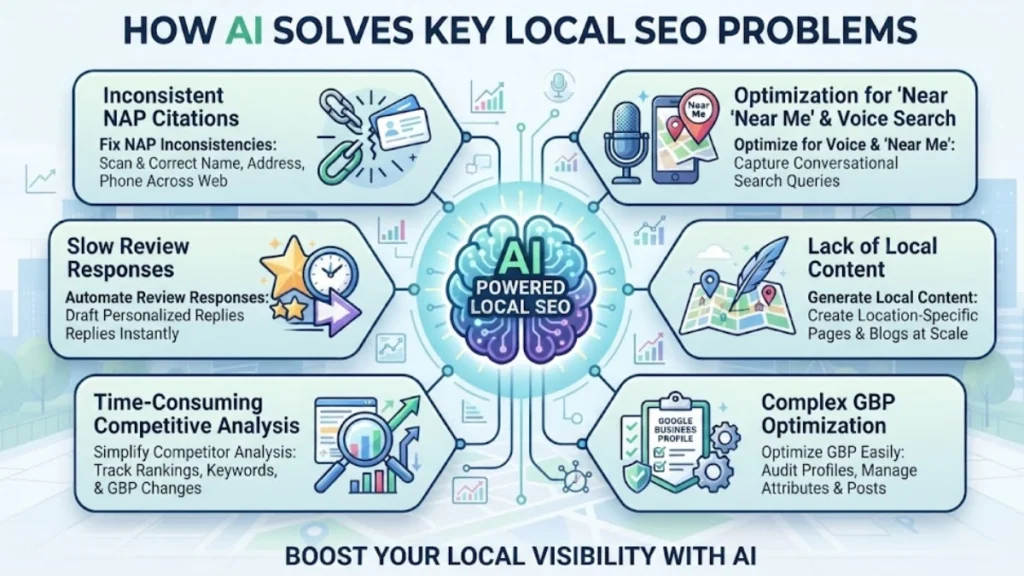
Which Local SEO Problems Can AI Help Solve?
AI becomes particularly useful when a business has too much information to review manually or does not know where to begin.
It can help identify patterns that might otherwise be overlooked, but every finding needs to be evaluated against the business’s actual goals.
Some common applications include:
- Keyword and intent research: grouping searches according to services, problems, locations, and buying stages.
- Content analysis: finding weak, outdated, incomplete, or overlapping pages.
- Competitor research: identifying subjects competitors cover and areas where their information may be limited.
- Customer-question research: organizing recurring questions that could become useful website content.
- Review analysis: identifying recurring themes in customer feedback that may reveal strengths, concerns, or content opportunities.
- SEO reporting: helping organize large amounts of performance information into easier-to-review summaries.
The important point is that AI can identify possibilities; it does not automatically know which possibility is commercially important.
A business should not create a new page simply because an AI tool recommends a topic. The question should always be: Will this page help a real customer and support a meaningful business objective?
What AI Cannot Fix for a Small Business
This is the part many AI SEO discussions overlook.
AI cannot repair every local visibility problem. If a business has inaccurate information, poor website usability, weak service descriptions, limited expertise, or an unconvincing customer experience, generating more content will not solve the underlying issue.
AI also cannot manufacture genuine authority.
A business needs real experience behind its claims. Case examples, knowledgeable explanations, accurate service information, legitimate customer feedback, and evidence of expertise are far more valuable than generic text produced simply to fill a website.
Technical problems can also require specialist attention. A slow website, confusing navigation, poor mobile experience, indexing problems, or an unclear site structure may need hands-on SEO and development work.
Recent discussion around AI search increasingly emphasizes that websites still need strong technical foundations and clear, accessible content for AI systems to interpret them effectively.
This is why AI search optimization for local businesses should not be treated as a shortcut around traditional SEO. It is better understood as an additional consideration within a broader search strategy.
When Is Professional Local SEO Worth Paying For?
Not every small business needs an agency immediately.
If you have a small website, understand your customers well, have time to learn SEO, and are comfortable analyzing your own data, AI tools can help you handle some research and planning.
The situation changes when SEO becomes difficult to manage or when the business cannot determine why its visibility is weak.
For example, you may have several services, multiple service areas, competing businesses with stronger websites, inconsistent business information, outdated pages, or technical issues that are difficult to diagnose.
In that situation, buying more tools may not be the answer.
A local SEO audit can provide a clearer starting point. Instead of guessing what needs improvement, the business can examine its website, local presence, content, technical setup, competitors, and other relevant areas before deciding where to invest.
This is also where SEO services for local business can become valuable. The purpose of professional support should be to provide strategy and implementation based on the business’s situation not simply to add AI-generated content every month.
If you’re comparing providers, don’t choose one simply because it claims to use the latest AI technology. Look for clear explanations, realistic expectations, relevant experience, transparent work and a strategy connected to your business objectives.