
Your business ranks well on Google near its physical location, but customers searching from neighboring communities struggle to find it. If this sounds familiar, you may be wondering whether your local SEO strategy is failing or whether Google has changed how it displays your business.
The answer depends on where the decline occurs and which searches are affected. Local search results vary by searcher’s location, the relevance of a business to the query, and its prominence online. A company can therefore appear prominently in one neighborhood and lower down in another without having a technical problem.
However, distance is not always the whole explanation. Incorrect business information, weak service pages, website indexing problems, and increased competition can also limit visibility.
The solution is to identify the reason before investing in more optimization. This guide explains how to diagnose local ranking changes, correct common problems, and build a practical strategy for reaching customers across your genuine service area.
1. Why Local SEO Rankings Change From One Location to Another
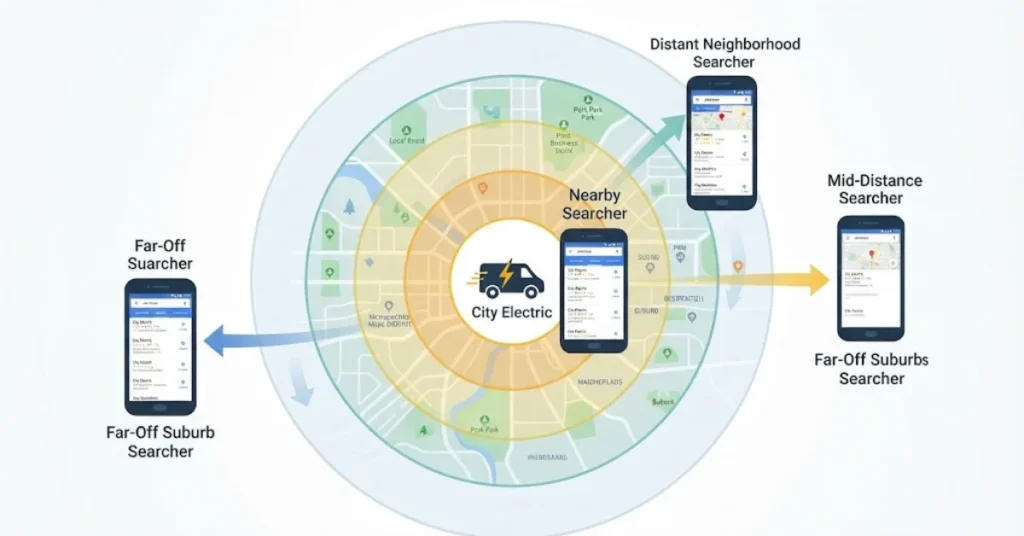
Google does not display one fixed set of local results to every searcher. The results can change according to the searcher’s location and the type of service or product they want.
Imagine an electrician whose business is located in one part of a city. Someone searching nearby may see the electrician in the local results, while a person searching from a distant neighborhood may see competitors located closer to them.
This geographic variation is a normal part of local search. It does not automatically mean the business has lost authority or that its website needs an immediate overhaul.
The important distinction is between a predictable distance-related decline and a sudden change that affects areas where your business previously performed well.
To understand the difference, compare results for the same search phrase across several locations. If visibility gradually decreases with distance, proximity may be a major factor. If rankings suddenly disappear across multiple areas, investigate possible changes to your website, Google Business Profile, or competitive environment.
Remember that your service area and your ranking area are not necessarily identical. Being willing to travel to a location does not guarantee that Google will rank your business there.
2. How to Diagnose the Cause Before Changing Your SEO
One of the most common mistakes in local SEO is making changes before identifying the problem. Adding keywords, editing a profile, or publishing more pages may not help if the actual issue is a technical error or normal geographic variation.
Start by identifying what has changed. Are you losing visibility only in Google Maps, or has organic website traffic also declined? Are all your services affected, or is the problem limited to a particular search? Did the decline happen gradually or immediately after a website update?
Use Google Search Console to compare organic impressions, clicks, queries, and landing-page performance. For local pack and Maps visibility, use a local rank-tracking tool that measures results across a consistent set of geographic points.
Check these two areas first:
- Search performance: Identify which search terms and website pages have lost impressions or clicks. Check whether the decline affects your entire site or only particular services.
- Geographic performance: Compare the same search terms across your important service locations. Look for patterns that distinguish distance-related variation from a broader loss of visibility.
Next, review the timeline. A website migration, new URL structure, indexing restriction, or major content change may explain an abrupt decline. A gradual change may point toward stronger competition, shifting demand, or changes in the local search landscape.
Avoid relying on a single ranking screenshot. Search results can vary, and one observation is not enough to establish the cause.
For further guidance, consult Google’s documentation on diagnosing search traffic drops.
3. Make Your Google Business Profile Accurate and Relevant
Once you have identified a profile-related problem, check whether your Google Business Profile accurately represents your business.
Your primary category should describe your main business activity, while additional categories should reflect genuine services where appropriate. Your operating hours, phone number, website link, and service information should also be current.
For service-area businesses, the profile should reflect the areas where the business actually operates. Do not add an address where you do not have an eligible business location or create multiple profiles simply to appear in more neighborhoods.
Also review whether customers can understand your services from the profile. Clear descriptions and accurate information help people decide whether to contact you.
Keep expectations realistic: completing every profile field or adding more service areas does not guarantee higher rankings farther away. Google considers several factors, including distance, and profile edits cannot remove that geographic limitation.
Use Google’s official local ranking guidance to review the factors involved and ensure your profile follows its guidelines.
4. Improve Website Relevance for the Areas You Actually Serve

A Google Business Profile is only one part of your online presence. Your website should also explain what you do, whom you help, and which services you provide in your actual operating area.
If every service is described on one generic page, visitors may struggle to find the details relevant to their needs. This can be particularly challenging for businesses offering several services across multiple communities.
Create dedicated pages when a service or location deserves its own useful explanation. Each page should answer meaningful customer questions, describe the relevant service, and provide clear next steps.
For example, a business targeting Denver customers could develop a location-focused service page that explains the work available, the types of customers it supports, and how to request an estimate. The page should provide genuine local value instead of repeating the city name throughout the text.
Useful location pages may include original project examples, relevant service details, local customer questions, or clear explanations of coverage. Avoid producing dozens of near-identical pages that differ only by neighborhood name.
Review your website structure as well. Important service pages should be linked from relevant navigation or supporting content, and their URLs should be accessible to search engines. If a valuable page has accidentally been blocked from indexing, adding more content will not solve that technical issue.
The objective is to help search engines understand the relationship between your services and your website while giving customers information that genuinely supports their decisions.
5. Correct Inconsistent Business Information Across the Web
When your business details differ across directories, customers may encounter outdated contact information or uncertainty about which listing is genuine. This can undermine trust and create unnecessary friction when someone tries to contact you.
Review your major business listings and check the accuracy of your business name, address where publicly applicable, phone number, website URL, and other relevant details. Pay particular attention to old phone numbers, duplicate profiles, outdated addresses, and listings that point to a previous website.
Prioritize directories that are credible and relevant to your industry or local market. Correct existing errors before spending time submitting your business to additional platforms.
Directory listings can support business discovery and reinforce consistent information, but they are not a guaranteed shortcut to better rankings. A large number of low-quality citations is less useful than an accurate, trustworthy online presence.
If your business has moved, changed its contact details, or undergone a rebrand, document the changes and update important listings systematically. This makes future maintenance easier and helps customers reach the right business.
6. Respond to Competitors and Changes in Local Search Demand
Sometimes your website and business profile are functioning correctly, but your visibility has declined because the local competitive landscape has changed.
A competitor may have improved its service pages, earned relevant local mentions, strengthened its reputation, or become more relevant to a particular search. Search demand can also shift as customers change how they describe a service or what they expect to find.
Compare your most important search terms with the businesses that currently appear prominently. Look for useful differences in their service information, page quality, reputation, and website experience.
Do not copy competitor content or attempt to reproduce every tactic you observe. Instead, identify where your own website leaves questions unanswered and improve those areas with accurate, original information.
Also check whether your pages match the intent behind the search. Someone looking for emergency assistance needs different information from someone comparing service providers for a future project.
If your page does not meet that need, a higher keyword count will not necessarily make it more useful. Clear service details, relevant information, credible evidence of experience, and an easy contact process are more sustainable improvements.
7. Measure Results and Build a Practical Local SEO Plan
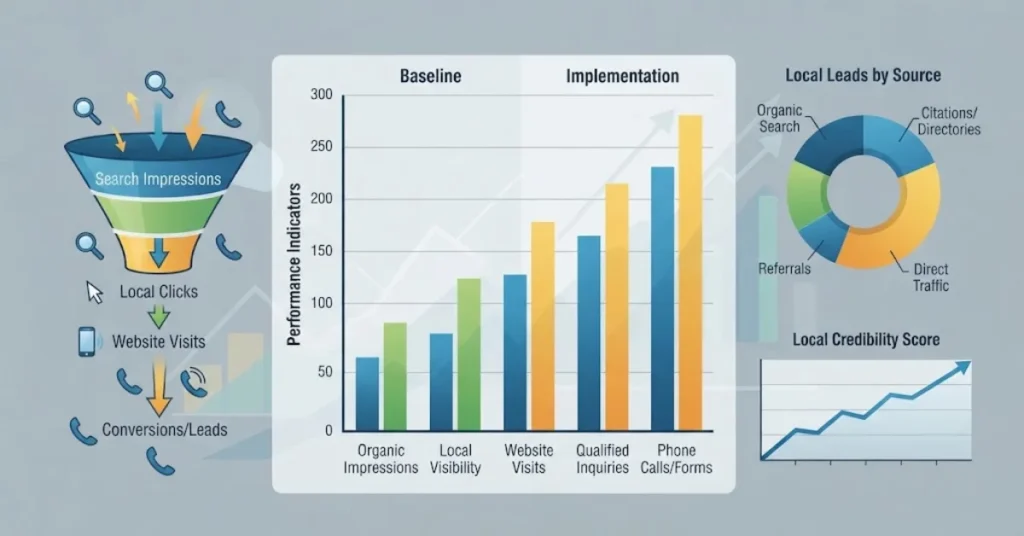
After making changes, measure whether they address the original problem. Without consistent tracking, it is difficult to tell whether an improvement helped, whether the market changed, or whether a ranking fluctuation was temporary.
Establish a baseline before making significant changes. Record the search terms, locations, pages, and performance indicators that matter to your business. Review the same measures after implementation rather than comparing unrelated periods or different tracking locations.
Your measurement process should include organic impressions and clicks, local visibility, relevant website visits, phone calls, contact forms, and qualified inquiries where tracking is available. Ranking positions are useful diagnostic indicators, but they are not the final measure of business success.
Prioritize work according to the evidence. Fix indexing problems before investing heavily in new content. Correct inaccurate business details before expanding citations. Improve service pages when they fail to answer customer questions. Strengthen local credibility when competitor analysis identifies a genuine gap.
A focused plan helps prevent repeated edits that produce little value. It also makes it easier to explain what has been changed and why.
For businesses that lack the time or expertise to conduct this analysis, professional local SEO support can help organize the audit, identify the most important issues, and establish a measurable improvement process.