When a customer searches for a nearby service, appearing in Google’s local results can make the difference between being discovered and being overlooked. Yet many businesses invest time in their website and Google Business Profile without understanding why another company continues to appear ahead of them.
The answer is not simply add more keywords. Google says local results are primarily influenced by relevance, distance, and prominence. These factors work together to determine which businesses are the best match for a particular search.
Understanding those three factors gives business owners a much clearer way to diagnose local visibility problems. Instead of making random profile edits or buying links without a strategy, you can identify what is missing and improve the signals that genuinely help customers find your business.
What Are Google Local Ranking Factors?
Local ranking factors are the signals Google uses to determine which businesses should appear for searches with local intent.
A person searching for “emergency plumber,” for example, is not looking for a general list of plumbers across the country. They usually want a relevant business that can provide the service in the area they need.
Google’s own documentation identifies three primary considerations:
Factor | What it means | What businesses should focus on |
Relevance | How closely the business matches the search | Accurate categories, services and useful business information |
Distance | How far the business is from the searcher’s location or specified location | Genuine location and service-area information |
Prominence | How well-known or established the business is | Reviews, links, mentions and broader online visibility |
These factors are not independent checkboxes. A business can be highly relevant but too far away for a particular search, while another may be nearby but provide a weaker match. Google combines the available signals to determine the results shown to the searcher.
That is why copying a competitor’s profile or adding a long list of keywords does not automatically improve local visibility.
1. Relevance: Does Your Business Match the Search?
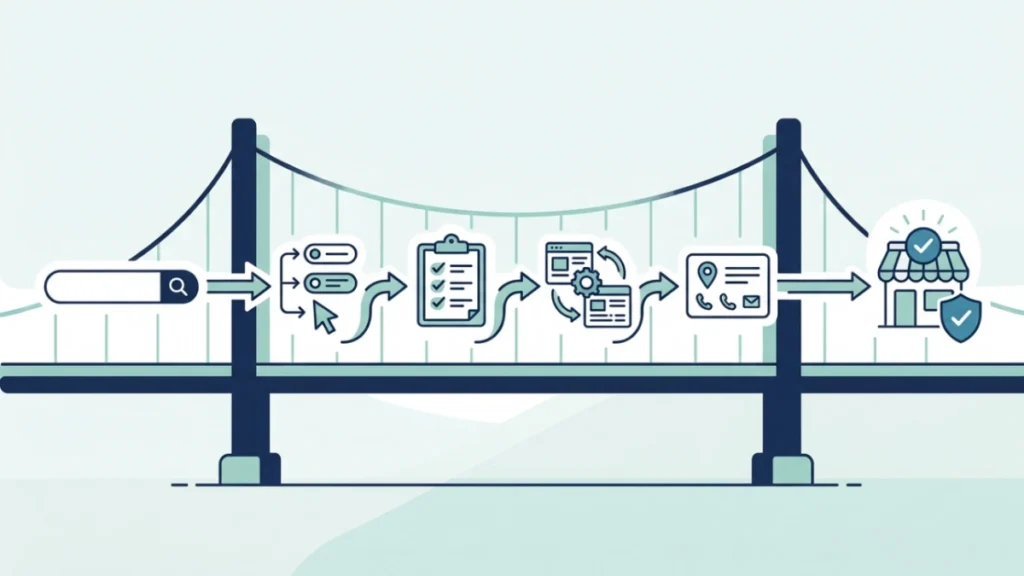
Relevance is about matching what the customer is actually looking for.
If someone searches for “family dentist,” Google needs enough reliable information to understand which businesses genuinely provide that service. Your Business Profile, website, categories, services and other online information can help establish that connection.
This is where Google Business Profile optimization starts to matter.
Your primary category should accurately represent the core business. Your services should describe what you genuinely provide, and your website should reinforce the same information without creating conflicting signals.
How to improve relevance
- Choose the most accurate primary category and appropriate secondary categories.
- Describe your actual services clearly.
- Make sure your website explains those services in useful, customer-focused language.
- Keep your business name, address, phone number and operating information accurate.
- Create pages for important services when those pages provide genuine value to visitors.
- Use relevant terminology naturally rather than repeating the same keyword throughout the page.
This is also where keyword prominence in SEO needs some context. Making a phrase visible in important parts of a page can help communicate the topic, but repeatedly inserting keywords does not create relevance by itself.
Google specifically recommends providing complete and detailed Business Profile information so it can better understand the business and match it with relevant searches.
2. Distance: How Close Is the Business?
Distance is easier to misunderstand.
Google considers how far a potential result is from the person searching. If the searcher specifies a location, that location can affect the calculation. If they do not, Google can use information it has about their location.
This explains why a business may appear prominently for a local search from one neighborhood but not appear in the same position when the search is performed somewhere else.
For example, a company located in central Denver may have different visibility from a searcher several miles away compared with someone searching from a nearby neighborhood. That does not necessarily mean the profile is broken.
Distance is also one reason businesses should be careful about unrealistic location strategies. Creating artificial locations or claiming addresses where the business does not genuinely operate can create more problems than it solves.
Instead, make the legitimate geographic information easy to understand across your Business Profile and website.
3. Prominence: How Well-Known Is the Business?
Prominence concerns how established and recognized a business is.
Google explains that prominence can be influenced by information it finds across the web, including links, articles and directories. Review count and review scores can also contribute to local ranking.
Your Business Profile is important, but it exists within a much larger online ecosystem.
A business with a well-maintained profile, strong website, legitimate customer reviews and references from relevant websites can provide Google with considerably more evidence about its presence and reputation.
That does not mean buying hundreds of backlinks is the answer. Top-quality link packages should never be treated as a shortcut to guaranteed Maps visibility. Google’s documentation states that there is no way to request or pay for a better local ranking.
The better approach is to earn relevant authority through useful content, legitimate partnerships, industry mentions, local publications and other credible references.
How Relevance, Distance and Prominence Work Together
The three factors become much easier to understand when you look at them as a combined system.
Imagine three businesses competing for the same local service search.
One may have excellent relevance but operate considerably farther away. Another may be very close but have incomplete business information. A third may have strong relevance and a substantial online presence but still be outside the searcher’s immediate area.
The result can change depending on the searcher’s location and the wording of the query.
That is why there is no universal checklist that guarantees a business will rank first.
Google also states that it does not allow businesses to request or pay for better local rankings, and the details of its ranking systems are kept confidential.
A sensible local SEO strategy therefore focuses on improving the information and reputation signals a business can legitimately control.
Best Practices for Google Business Profile Management
A Business Profile is effectively a local entry point between your company and customers searching through Google Search or Maps.
For eligible businesses, Google allows owners to manage information such as hours, phone number, location, website, photos and other details. Businesses can also respond to customer reviews.
A practical profile review should cover:
- Verification and accuracy: Confirm the profile is verified and the core information is correct.
- Business category: Check that the category accurately represents what the company does.
- Services: Make sure listed services reflect what customers can actually purchase.
- Hours: Keep normal and special hours current.
- Reviews: Respond professionally and consistently to genuine customer feedback.
- Photos: Use authentic images that help customers understand the business.
- Website connection: Make sure the linked website supports the same business information.
Google also provides Business Profile performance information, including searches, views, calls, website clicks and other interactions for eligible verified profiles. This data can help businesses understand how customers discover and interact with their listing.
Your Google Business Profile Is Only One Part of the Picture
A complete Business Profile matters, but local search should not be treated as a profile-only marketing channel.
Google recommends verifying the business, keeping its information current, responding to reviews, and adding photos and videos.
Those actions improve the information available to customers and can help Google understand the business.
But there is another layer: the website.
Suppose your profile says you provide a particular service, but your website provides almost no useful information about that service. The profile and website are not working together as effectively as they could.
A stronger local presence connects the two:
Business Profile → relevant service information → useful website experience → genuine reputation
That is a more sustainable approach than repeatedly editing the same profile description.
What to Check When Your Local Visibility Is Weak
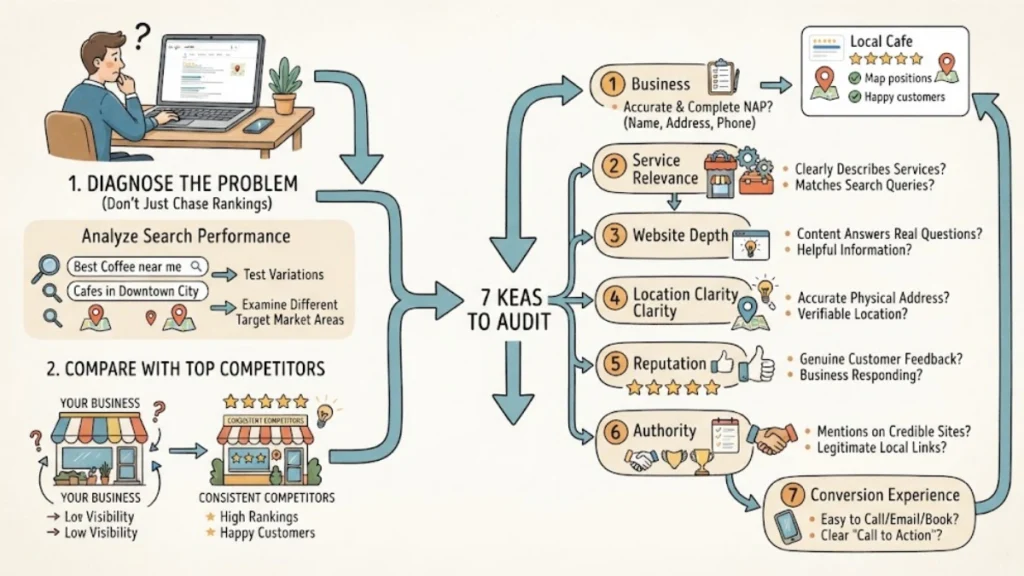
Before ordering more backlinks or rewriting your profile for the tenth time, diagnose the problem.
Search for the important services your customers actually use. Test variations of the query and, where practical, examine results from different parts of your target market.
Then compare your business with the companies appearing consistently.
Look at:
Business information: Is everything accurate and complete?
Service relevance: Does your profile clearly describe the services customers search for?
Website depth: Does the corresponding website content answer real customer questions?
Location clarity: Is the legitimate business location represented accurately?
Reputation: Are customers leaving genuine feedback, and is the business responding?
Authority: Are credible websites and organizations mentioning or linking to the business?
Conversion experience: Once someone finds you, can they easily call, request a quote, book, or take the next appropriate step?
This type of audit is more useful than chasing an arbitrary ranking position because it identifies the underlying weakness.
A Better Way to Improve Local Visibility
There is no single optimization that guarantees a place in Google’s local results. Google explicitly says businesses cannot request or pay for better local rankings and that the details of its ranking systems are kept confidential.
Instead, work through the areas you can control.
First, clarify the business: Make sure your category, services, contact information, hours, website and other profile details accurately represent the company.
Second, strengthen the customer experience: Build service pages and helpful content around genuine customer needs rather than producing pages solely to insert location keywords.
Third, develop reputation: Encourage legitimate customers to share their experiences and respond professionally to feedback.
Fourth, build authority naturally: Seek relevant partnerships, industry mentions, local coverage and useful resources that can earn credible references.
Finally, measure the outcome: Profile performance data can provide information about how customers discover and interact with a Business Profile, helping you identify where further work is needed.