When someone searches for a business, they usually have a specific reason for doing it. They may want to understand a problem, compare nearby options, find a business they already know, or take action immediately.
The words they enter into Google provide clues about that goal. That is the foundation of local search intent.
For a local business, ranking for a large number of searches is not enough if those searches do not match what potential customers actually need. A service page that appears for an informational query may attract visitors but fail to generate enquiries. Likewise, a helpful guide may build visibility while a customer-ready search requires a much more direct page.
Understanding the purpose behind a search allows businesses to create pages, listings, and content that are useful at the right moment. It also creates a stronger connection between SEO visibility and real business outcomes.
What Is Local Search Intent?
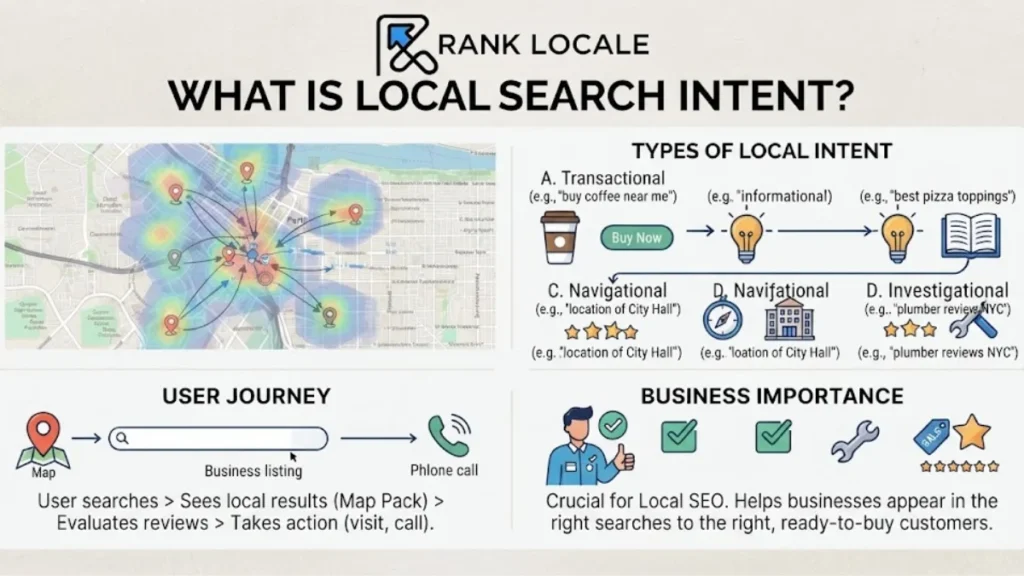
Local search intent describes the reason behind a search that has a geographic connection. The searcher is looking for information, a product, service, business, or location that is relevant to a particular area.
Some searches make the location obvious through phrases such as near me, a city name, neighborhood, or open now. Others have local intent even when no location is written because the search itself commonly produces nearby results.
For example, a person searching for an emergency plumber may not type a city into the query. Their expectation is still likely to involve a provider that can reach them.
This distinction matters because SEO should not focus only on individual keywords. It should consider what the searcher expects to find after making the search.
Research on local search intent commonly divides these searches into informational, commercial, transactional, and navigational categories.
The Four Intent Types Behind Local Searches
Informational Intent: The Searcher Wants an Answer
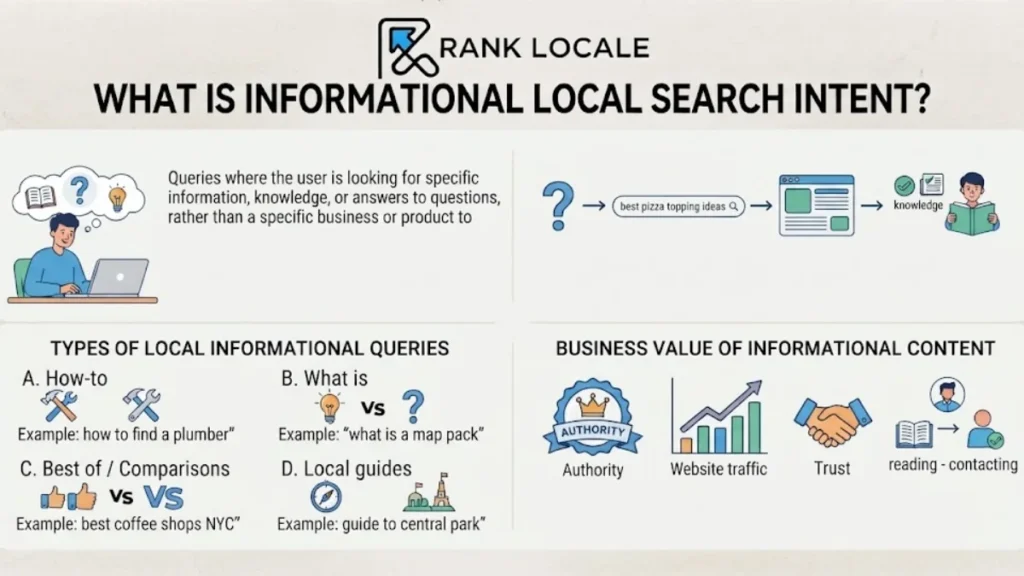
Informational searches happen when someone is learning or trying to solve a problem.
Examples might include:
- how much does a roof inspection cost
- how often should a business website be updated
- what does a local SEO audit include
The person may not be ready to contact a company yet. Their first requirement is useful information.
For businesses, this creates an opportunity to publish genuinely helpful guides, explanations, checklists, and educational resources. The objective is not to turn every visitor into a customer immediately. It is to demonstrate knowledge and provide a useful next step when the reader is ready.
Commercial Intent: The Searcher Is Comparing Options
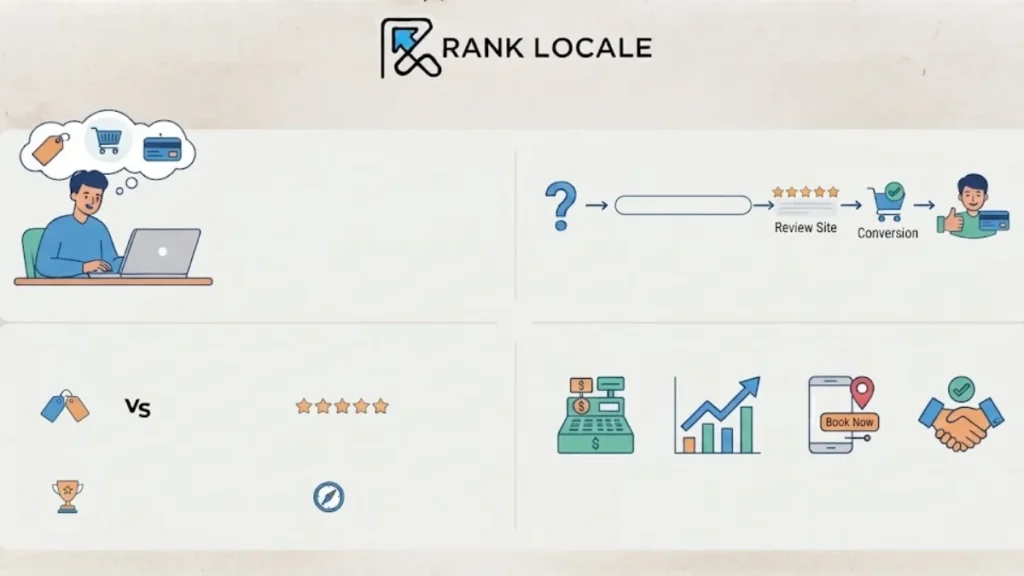
Commercial searches sit closer to a buying decision. The user has identified a need and is investigating which businesses, products, or services could satisfy it.
Queries such as best SEO services for local business or local SEO company can indicate that the searcher is evaluating providers.
At this stage, content should answer practical decision-making questions. Clear service descriptions, relevant experience, examples of work, transparent processes, and useful FAQs can help visitors understand whether a provider fits their needs.
Transactional Intent: The Searcher Is Ready to Act
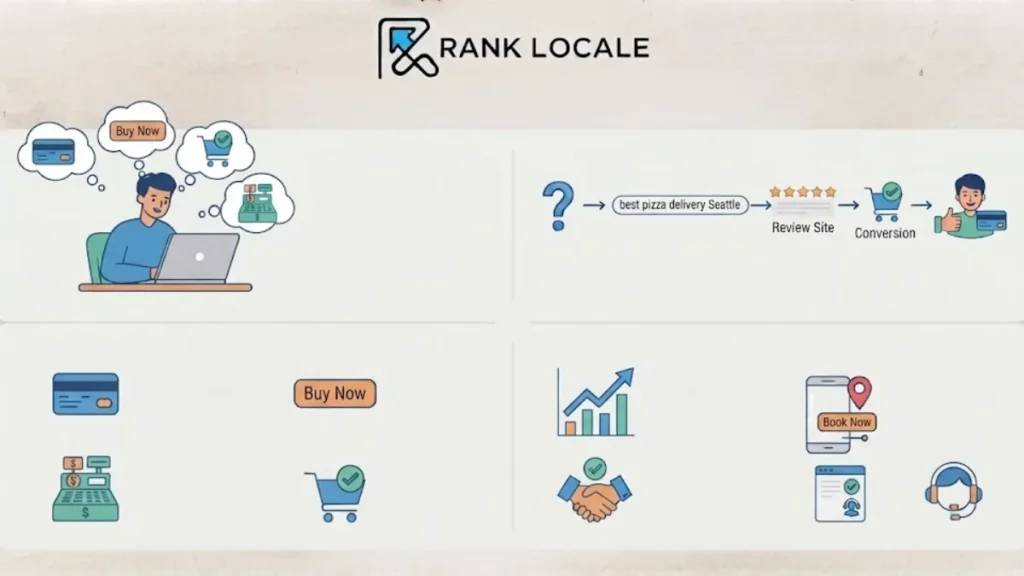
Transactional intent indicates a stronger desire to complete an action.
The search might contain terms such as:
- book
- hire
- quote
- service
- appointment
- near me
- open now
A person searching this way may already understand what they need. Sending them to a long educational article can create unnecessary friction.
A dedicated service page with clear information, contact options, location relevance, and a straightforward next step is generally more aligned with this stage.
Navigational Intent: The Searcher Has a Destination in Mind
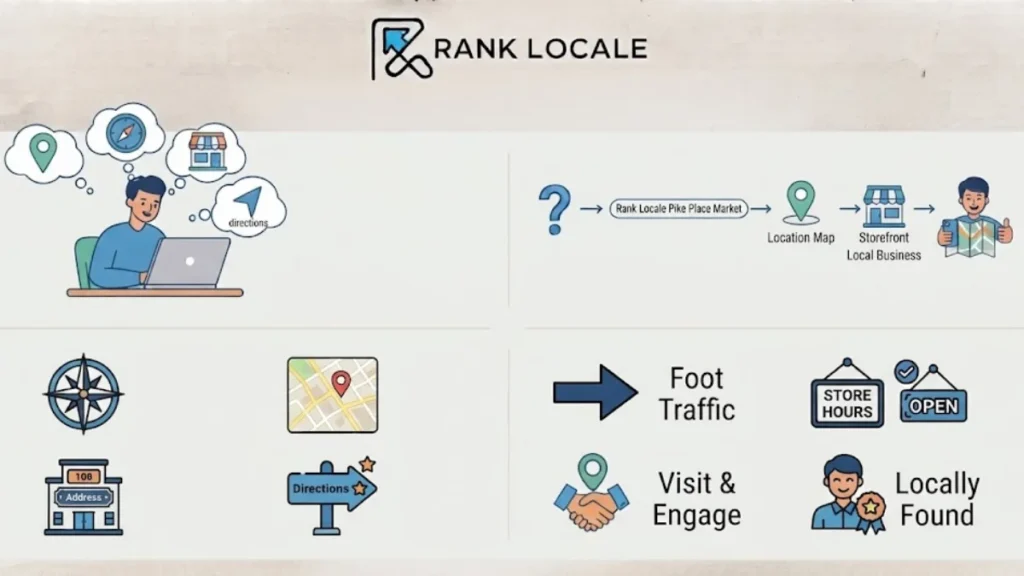
Navigational searches occur when someone is trying to locate a particular business, website, branch, or destination.
For example, someone might search for a company name followed by a city or location.
Here, accuracy matters. Your business name, website, contact information, address, hours, and other important details should be consistent wherever customers may encounter them.
How to Identify the Intent Behind a Local Keyword
A keyword by itself does not always tell the complete story. The surrounding language and the results Google presents can provide additional clues.
Start by asking what the person would reasonably expect after searching.
If the query asks how, why, what, or when, educational content may be appropriate. If it includes comparison language such as best, top, reviews, or cost, the searcher may be evaluating options. Words such as hire, book, quote, or service often indicate a stronger commercial or transactional need.
You can also examine the current search results. If Google consistently shows service pages, local business profiles, maps, or comparison-style content for a query, that provides useful evidence about the type of result users are being given.
Search intent can also change. A phrase that once produced mostly informational pages may develop stronger commercial intent as user behavior and the market evolve. Regularly reviewing search results helps keep your content aligned with what people actually expect.
Match the Page to the Customer’s Goal
One of the most common local SEO mistakes is trying to make one page rank for every possible variation of a topic.
Instead, give each important page a clear purpose.
An educational article can answer a problem and naturally guide readers toward a relevant service. A service page can explain what the business does and help qualified visitors take action. A location page can establish geographic relevance when the business genuinely operates in that area.
This creates a more logical website structure.
For example, a business might have an educational article explaining how local visibility works, a dedicated local SEO service page describing its process, and supporting location-focused pages where those services are genuinely available.
The pages work together without competing to answer exactly the same question.
Turn Search Intent Into a Local SEO Strategy
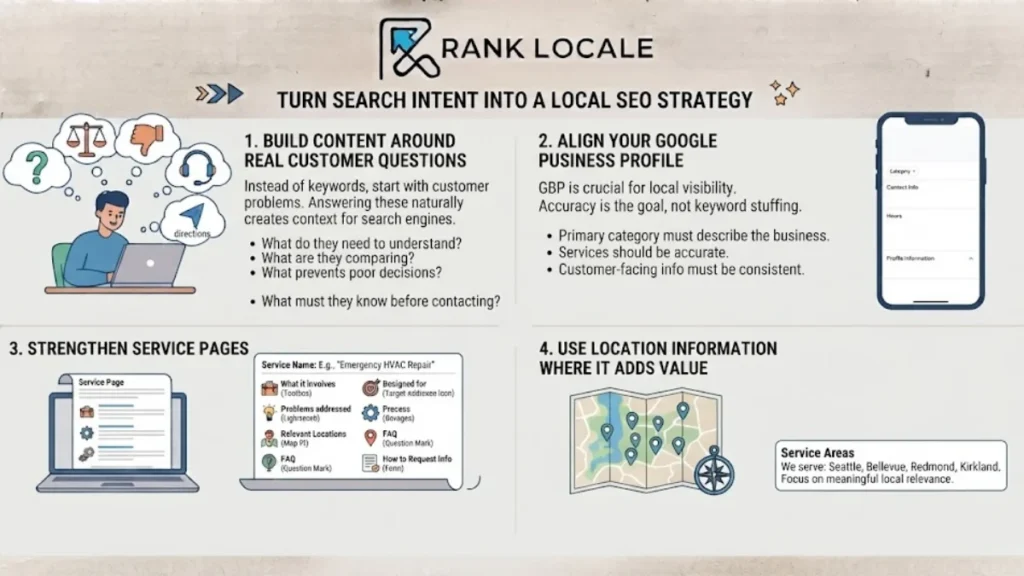
Understanding intent becomes valuable when it influences the wider optimization process.
Build Content Around Real Customer Questions
Instead of starting with a list of keywords and writing around them, start with customer problems.
What does a potential customer need to understand? What are they comparing? What information could prevent a poor decision? What would they need to know before contacting a provider?
Answering those questions naturally creates useful content while giving search engines clearer context about the subject.
Align Your Google Business Profile With the Business
Google Business Profile information is an important part of local visibility because it gives searchers practical details about a business, including its category, contact information, hours, location, and other profile information. Local SEO guidance commonly recommends keeping these details accurate and maintaining relevant business information.
The goal should be accuracy rather than adding keywords wherever possible.
Your primary category should accurately describe the business, services should reflect what you actually provide, and customer-facing information should remain consistent.
Strengthen Service Pages
A strong service page should answer the questions a potential customer has before contacting the business.
Depending on the service, that may include:
- What the service involves
- Who it is designed for
- Problems it can address
- What the process looks like
- Relevant areas or locations
- Frequently asked questions
- How to request more information
This is more useful than creating a page that simply repeats a service keyword in multiple headings.
Use Location Information Where It Adds Value
Local relevance should be meaningful.
Mention the areas where the business genuinely operates, explain relevant local considerations, and make the page useful to someone in that market. Location information should help the customer understand whether the business can actually help them.
This approach is more useful than producing near-identical pages with only the city name changed.
Local SEO for Small Business Should Follow the Customer Journey
Small businesses often have limited resources, so every page should have a clear purpose.
A practical content strategy can cover the customer journey from education to evaluation and action. Educational articles can attract people researching a problem. Comparison-focused content can help people evaluating solutions. Service pages can address customers who are ready to enquire.
This also creates opportunities for internal linking.
An informational article can link naturally to a relevant service page when that page provides the next useful step. A service page can point visitors toward a detailed guide when additional information would help them make a decision.
The result is a website that works as a connected resource rather than a collection of isolated pages.
Why Search Intent Matters More Than Keyword Repetition
Adding a keyword repeatedly does not automatically make a page more relevant.
Modern search optimization is better approached through relevance, usefulness, clear information architecture, and satisfying the reason someone searched in the first place. Search-intent guidance similarly emphasizes creating content that matches the purpose behind a query rather than treating keywords as isolated phrases.
That means a page can naturally include related concepts without forcing the same phrase into every paragraph.
For example, a page about local SEO for small businesses can discuss Google Business Profile optimization, service pages, local content, customer reviews, geographic relevance, technical performance, and lead generation without repeatedly inserting the exact target phrase.
Natural language helps the reader first. Clear topical relationships help search engines understand the page.
Measure Whether Your Content Is Attracting the Right Searches
Traffic alone does not tell you whether your strategy is working.
Look beyond total visits and examine the quality and relevance of the traffic reaching important pages. Search Console data can help identify queries, impressions, clicks, click-through rates, and pages receiving organic visibility.
For local businesses, useful business outcomes may include:
- Relevant enquiries
- Phone calls
- Form submissions
- Appointment requests
- Direction requests
- Qualified website visitors
- Visibility for important service searches
A page that receives fewer visits but produces relevant enquiries can be more valuable than a page attracting large amounts of unrelated traffic.
The important question is not simply: How much traffic did this page get?
It is: Did this page reach people who were looking for what the business provides?