A construction company can have years of experience, completed projects, and a professional website and still be difficult to find when potential customers search for answers online.
The problem becomes more noticeable as search continues to change. Instead of typing a short phrase into Google, people increasingly ask detailed, specific questions about contractors, project types, costs, timelines, and what to consider before hiring.
Search engines are evolving to answer those questions directly, which means a construction website needs to do more than rank.
It needs to be understood. That shift is what Answer Engine Optimization (AEO) addresses: structuring your content so search systems can read it, interpret it, and confidently surface it when a potential client is looking for exactly what you offer.
For a Denver construction business, this creates a practical question: Can a search system clearly understand what your company does, where you work, what projects you handle, and why your information is worth using?
Improving that visibility does not require filling pages with AI-related keywords. Google’s guidance continues to emphasize useful content, technical accessibility, and established SEO fundamentals for its AI search experiences.
The real opportunity is to make the website clearer, more useful, and more trustworthy.
Why AI Search Can Miss a Good Construction Company
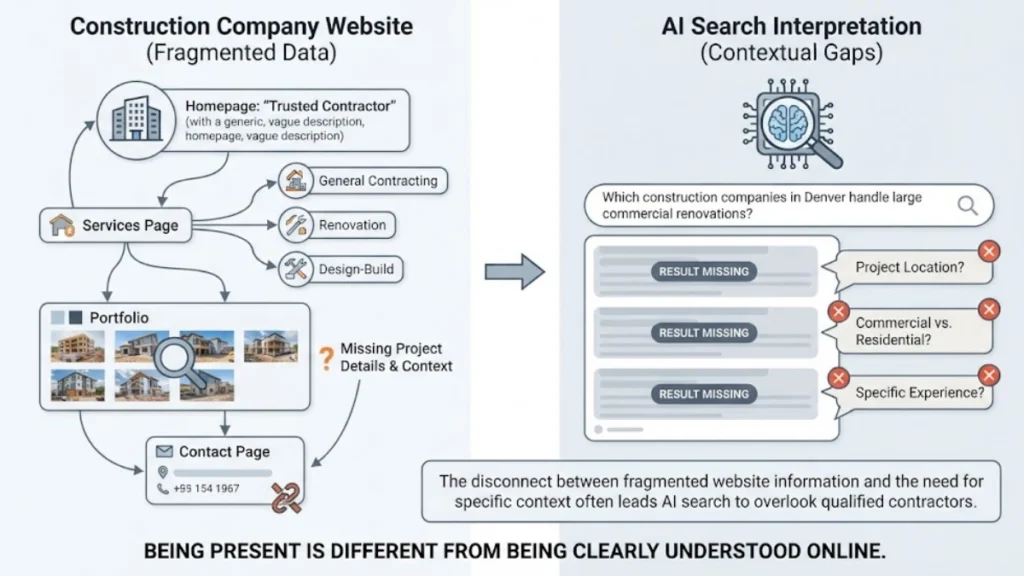
Construction websites often contain the information customers need, but that information is not always presented clearly.
A homepage might say that a company is a trusted contractor. A services page might list several capabilities. A portfolio might show attractive photographs without explaining the project. A contact page might provide an address and phone number.
Individually, these pieces are useful. Together, however, they may not give search systems enough context.
A prospective client could ask:
- Which construction companies in Denver handle this type of project?
- Does this builder work on commercial or residential properties?
- What areas does the company cover?
- Does the contractor have experience with similar projects?
- What services are available before construction begins?
Your website should make those answers easy to find.
This is an important part of construction online visibility: being present online is different from being clearly understood online.
Start With the Questions Behind the Search
Before changing keywords, look at the questions a real customer would ask.
Someone planning a construction project usually has a problem to solve rather than an interest in SEO terminology. They may be comparing contractors, researching a service, checking whether a company handles a particular project, or trying to understand the next step.
That makes customer questions valuable sources for content.
For example, a company specializing in commercial work could explain how the initial planning process works, what information is needed before an estimate, how project scope affects timelines, and when specialized professionals may become involved.
A builder could answer questions about new construction, design-build work, remodeling, project management, or selecting the appropriate contractor.
This approach naturally supports better search visibility because the content is built around genuine search intent rather than repeated keyword variations.
It also creates material that can be useful to both prospective clients and search systems.
Make Every Important Service Easy to Understand
One of the biggest improvements a construction website can make is separating its services clearly.
If everything is placed on one broad page, a visitor may struggle to determine whether the company actually specializes in the work they need.
Instead, important services should have focused pages where appropriate.
Each page should explain:
- What the service involves
- Which types of clients or projects it suits
- What the company actually handles
- Important planning considerations
- Relevant experience or examples
- The next practical step for the customer
The objective is not to create a page for every possible keyword. It is to create useful pages for meaningful services.
That distinction matters for search visibility because a well-defined website gives search engines stronger context while giving potential customers a clearer path through the site.
Use Denver as Context, Not Decoration
Adding “Denver” to every heading does not automatically create local relevance.
A better local seo strategy connects the location with information that matters to the customer.
A construction website can naturally explain the areas it works in, the types of projects it completes locally, relevant regional considerations, and the communities or property types it understands.
The same principle applies to denver local seo marketing. Local optimization should reinforce genuine business information instead of turning every paragraph into a collection of geographic keywords.
For example, a service page can explain where the company provides that service. A project case study can identify the location when appropriate. A local resource can discuss questions that property owners in the area commonly face.
That creates useful geographic context without making the writing sound artificial.
Turn Completed Projects Into Evidence
A construction company has an advantage that many industries do not: its work can often be demonstrated.
Instead of treating the portfolio as a collection of photographs, turn suitable projects into useful case studies.
Explain what the project involved, the company’s role, the type of work performed, and any meaningful challenge or consideration that can be publicly discussed.
For example, rather than simply displaying:
Commercial Construction-Denver
A Case study could explain the project scope, construction approach, services provided, and relevant outcome.
That information demonstrates experience rather than merely claiming it.
It also gives search systems more specific information to associate with the company.
For construction and engineering businesses, first-hand project information can be particularly valuable because it adds details that generic industry articles cannot easily reproduce.
The same principle applies to builders: real project experience can provide stronger evidence than another generic article explaining what construction means.
Put the Most Useful Information Where People Can Find It
A website can contain excellent information and still underperform if important details are buried.
Visitors should not have to read several paragraphs before discovering what a service page actually covers.
Start important pages with a concise explanation of the service and its purpose. Follow with clearly separated sections that answer the most relevant questions.
This does not mean shortening every page. It means improving the information hierarchy.
The first part of a page should establish what the page is about. Supporting sections can then provide depth.
This is especially relevant to AI-oriented search because clearly organized content is easier for systems to interpret and for people to scan. Research from Huemor similarly emphasizes focused pages, clear sections, direct answers, and useful information rather than simply adding more words.
Check the Technical Side Before Publishing More Content
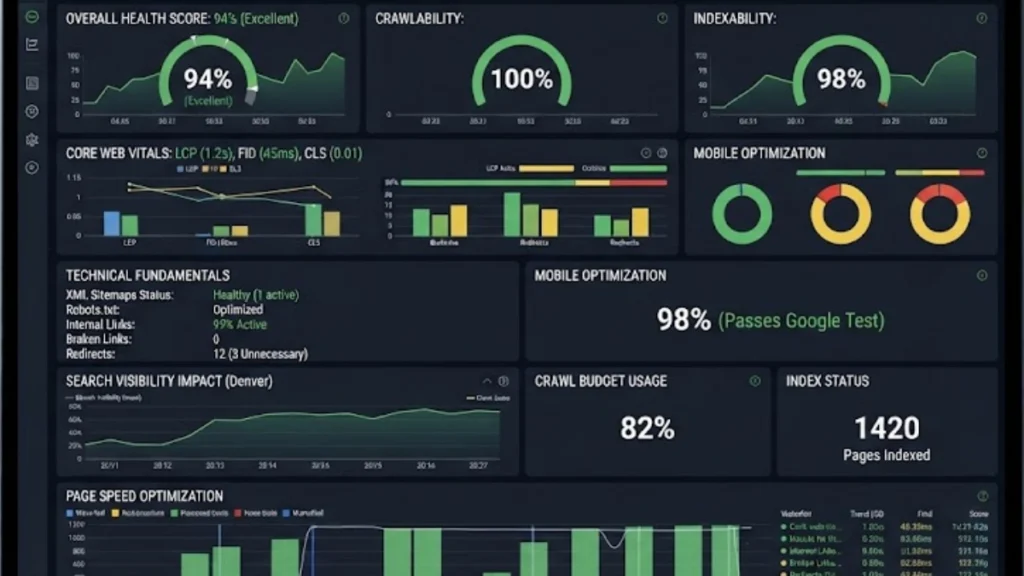
Content cannot compensate for a website that search engines struggle to access.
A technical review should check whether important pages can be crawled and indexed and whether visitors can use the site comfortably on different devices.
Look at the fundamentals:
- Indexability and crawlability
- Internal links
- XML sitemap
- Mobile experience
- Page speed and Core Web Vitals
- Broken links and unnecessary redirects
- Page titles and descriptions
- Canonical URLs
- Image handling
- Clear URL structures
Google’s documentation continues to identify crawlability, indexability, and technical accessibility as important parts of search visibility.
This is where website optimization denver becomes more than a keyword. If a valuable service page is difficult to discover or technically inaccessible, improving the content alone will not solve the underlying problem.
Connect Your Services, Projects, and Expertise
Think of the website as one connected knowledge system.
A construction service page can link to relevant project examples. A project case study can link to the service involved. An educational article can point readers toward the appropriate service page.
For example, an article explaining construction planning might naturally connect to a construction management page and a related project example.
This helps visitors move from learning to evaluating.
It also creates stronger relationships between pages.
A thoughtful search engine optimization in Denver strategy therefore looks beyond individual keywords. It considers how the website communicates its expertise as a whole.
The goal is to make the relationship between the company’s services, experience, locations, and supporting information obvious.
Build Trust Beyond Your Own Website
AI visibility is not created entirely on one domain.
A company’s broader digital presence can provide additional context. Consistent business information, legitimate industry references, relevant directories, reviews, professional profiles, and third-party mentions can all contribute to how a business is represented online.
That does not mean creating hundreds of low-quality directory listings or trying to manufacture mentions.
Consistency matters more than volume.
The company’s name, services, location, contact information, and areas of expertise should be represented accurately wherever the business has a legitimate presence.
This complements Local seo strategies companies can use to build a stronger local search foundation while reducing conflicting information.
Create Content That Supports the Buying Journey
A construction blog should not exist simply because a website “needs a blog.”
Each article should have a reason to exist.
One article might help someone understand whether a particular service is appropriate. Another might explain how to prepare for a project. A case study might demonstrate relevant experience. A local guide might answer questions property owners commonly encounter.
This is where denver blog seo tips become more useful when treated as a content-planning issue rather than a keyword exercise.
A practical content calendar can cover different stages of the customer’s decision:
Research: Explain unfamiliar construction concepts and planning questions.
Evaluation: Help readers compare approaches, services, or contractor considerations.
Decision: Provide project evidence, service details, and information about working with the company.
The result is a content library that supports actual customers rather than producing disconnected posts.
Measure Visibility by More Than Rankings
Traditional rankings still matter, but they should not be the only measurement.
A construction business should monitor whether important pages are being indexed, which searches generate impressions, whether qualified visitors reach service pages, and whether organic visitors take meaningful actions.
Google Search Console can provide information about search performance, while broader analytics can help connect website activity with business goals.
For AI search, also test realistic customer questions periodically.
Ask questions related to the company’s actual services and market and see whether the business is accurately represented.
Do not treat one AI response as a permanent ranking position. AI-generated results can change depending on the question, source information, location, and search experience.
The more useful question is:
Does the online presence give search systems enough accurate information to understand the business correctly?
A Practical Starting Point for a Denver Construction Website
If a construction website needs better visibility, start with the pages closest to the customer decision.
Review the main service pages first. Make sure they clearly explain what the company does and who the service is for.
Then review local information, project evidence, technical accessibility, internal links, and supporting content.
After those improvements, identify questions that customers still cannot answer from the website and build useful resources around them.
This creates a stronger foundation for construction seo than publishing large quantities of repetitive content.
It also avoids a common mistake: treating AI search as a completely separate marketing system.
The underlying goal remains straightforward help search systems understand the business and help customers find useful answers.