A construction company can have years of experience, impressive projects, and satisfied clients yet remain difficult to find online. For builders, the problem is not always a lack of expertise. Often, the website simply does not communicate that expertise in a way modern search systems can understand.
That creates a new question for construction businesses in Denver: should you invest in traditional SEO, AI-focused optimization, or both?
The answer becomes clearer when you look at what each approach is designed to accomplish. Traditional SEO remains important for organic rankings, technical accessibility, local visibility, and service discovery. AI-oriented optimization adds another layer by helping search systems understand a company’s expertise and information when people search through conversational or generative experiences.
For builders, the strongest strategy is not about choosing a fashionable alternative to SEO. It is about building a search presence that works across the ways potential customers now research construction services.
The Real Search Problem for Construction Companies
Construction searches are rarely limited to someone typing a company name into Google.
A potential customer may begin with a broad search for a builder, narrow the search to a particular service, compare several companies, investigate a project type, or ask a conversational question about choosing the right contractor.
That means a construction website has to serve several stages of the buying journey.
Someone searching for a custom home builder is different from someone researching construction costs. A person looking for a local remodeling company has a different need from someone comparing commercial construction providers.
This is why simply publishing more pages is not necessarily an SEO strategy.
The website needs a logical relationship between its services, locations, expertise, and the questions potential customers are trying to answer.
Traditional SEO Still Does the Essential Groundwork
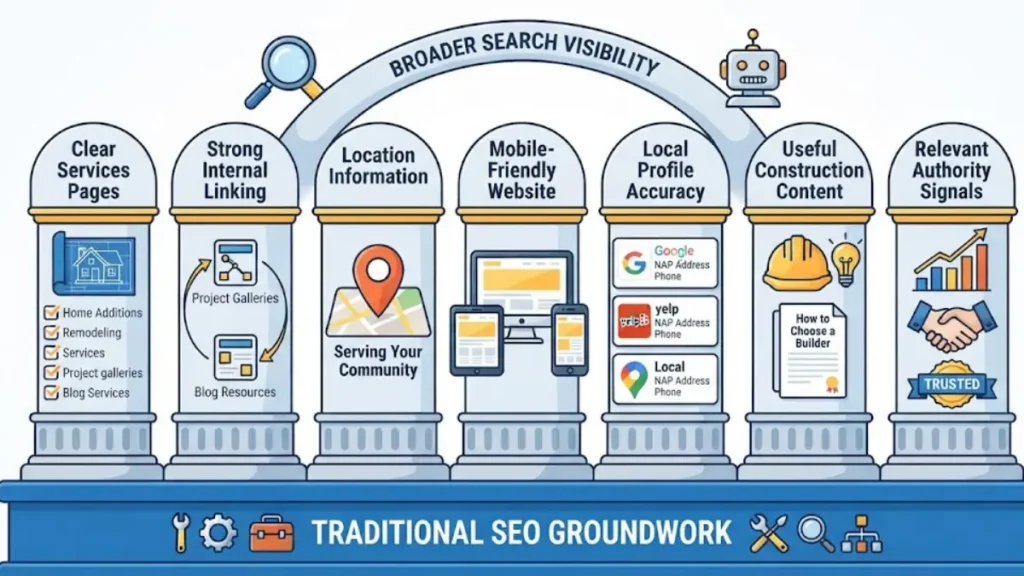
Traditional SEO is the foundation on which a construction company’s broader search visibility is built.
It helps search engines discover important pages, understand what those pages are about, associate services with relevant locations, and determine whether a website provides useful information.
For builders, this can involve everything from technical website health to service-page relevance and local signals.
A strong SEO for builders strategy should therefore begin with the fundamentals rather than treating AI visibility as a replacement for them.
Important areas include:
- Clear pages for important construction services and project types
- Strong internal linking between related services and supporting resources
- Location information that reflects where the company genuinely operates
- A technically accessible, mobile-friendly website
- Accurate business information across important local profiles
- Useful content demonstrating real construction knowledge
- Relevant authority signals from reputable sources
These elements remain valuable whether a person discovers the business through a traditional search result or through an AI-assisted search experience.
Why Home Builder SEO Needs a Different Approach
A home builder is not competing for exactly the same searches as every other construction business.
SEO for home builders needs to reflect the decisions homeowners make before choosing a company. They may want to understand construction processes, project timelines, design considerations, financing questions, permitting issues, materials, or differences between construction approaches.
For a custom builder, the buying journey can be particularly research-heavy because the project is significant and the decision involves trust.
That makes SEO for custom home builders less about repeating a service phrase and more about demonstrating expertise around the actual project.
The same principle applies to SEO services for home builders. A useful strategy should be built around the company’s market, services, project types, and competitive search landscape rather than a generic list of keywords.
Where AI Search Changes the Evaluation Process
AI-powered search changes the way information may be presented to a potential customer.
Instead of receiving a page of links and deciding which websites to open, a person can ask a detailed question and receive a synthesized response.
This changes the visibility objective.
Traditional SEO is strongly concerned with whether a page can earn visibility within search results. Generative search introduces another consideration: whether a company’s information is clear, credible, and relevant enough to be incorporated into an answer.
That is the practical reason businesses are discussing AI optimization.
It does not mean that a company can simply add AI-related keywords to its website and expect an AI system to recommend it.
The information itself needs substance.
AI Optimization vs. SEO: What Actually Changes?
The phrase AI optimization vs SEO can make the two approaches sound like competing systems. In practice, there is considerable overlap.
Traditional SEO concentrates heavily on search visibility, technical accessibility, relevance, authority, and user intent.
AI-oriented optimization places additional emphasis on whether information can be interpreted within conversational questions and whether the business has a sufficiently clear and credible presence across relevant sources.
For a construction company, that means explaining things that a potential client genuinely needs to know.
Instead of creating a page that repeatedly says “Denver construction company,” a stronger resource might explain how to evaluate a builder, what experience matters for a particular project, what questions should be asked before signing a contract, or what factors influence a construction timeline.
The information becomes useful independently of the search technology delivering it.
GEO vs. Traditional SEO: The Practical Difference
GEO vs traditional SEO differences are easier to understand when the two are viewed as different visibility environments.
Traditional SEO generally aims to earn visibility within search results.
Generative Engine Optimization, or GEO, is concerned with how information may be surfaced, summarized, cited, or referenced within AI-generated answers.
The signals are not necessarily identical. Traditional search places substantial importance on factors such as technical accessibility, relevance, links, and local search signals. Generative systems may also consider the clarity of information, consistency, authority, reputation, and supporting references across the broader web.
That does not make traditional SEO obsolete.
In fact, a technically weak website with unclear services and poor information architecture is unlikely to become strong simply because an AI strategy has been added.
The Difference Between SEO and LLM Prompt Coverage
There is another distinction worth making: the difference between traditional SEO and LLM prompt coverage.
Traditional keyword research often starts with phrases people enter into a search engine.
Conversational search can involve much longer questions. A homeowner might ask: Which type of builder should I hire for a custom home project?
That question contains several underlying needs. The person may want to understand experience, project scope, communication, timelines, costs, and qualifications.
A useful website can address those needs through several interconnected resources rather than trying to create one page for every possible prompt.
This is where genuine expertise becomes important.
AI can help identify patterns and organize information, but it should not replace knowledge from people who actually understand construction.
Why Generic AI Content Can Become a Problem
Using AI to assist with research, organization, or drafting is not the same as publishing generic AI-generated content without meaningful expertise.
For construction companies, credibility matters because customers are making expensive and consequential decisions.
A page filled with broad statements that could apply to any builder in any city gives a searcher very little reason to trust the company.
Builder content becomes more useful when it incorporates real experience: project considerations, common client questions, regional factors, construction decisions, lessons learned, and explanations that reflect the company’s actual knowledge.
This creates a stronger form of E-E-A-T because the content demonstrates experience and expertise rather than merely claiming them.
The goal should be human expertise supported by technology, not technology pretending to be expertise.
Local Search Is Still Critical for Builders
Construction services are geographically constrained. A business may serve Denver and surrounding communities but have no reason to compete for searches in markets where it cannot realistically take projects.
That makes local relevance essential.
A SEO for local builders strategy should connect the company’s actual service area with its individual services and project types.
Location pages should also provide genuine local value. Simply replacing a city name throughout identical copy does not create a useful local resource.
The same principle applies to searches such as home builder SEO near me. Proximity is only useful when supported by accurate business information, relevant services, and evidence that the company genuinely serves the area.
For builders, local search is not merely about adding city names. It is about making the relationship between the business, its services, and its market clear.
What a Modern Builder SEO Strategy Should Combine
A construction company does not need two disconnected marketing systems one for Google and another for AI.
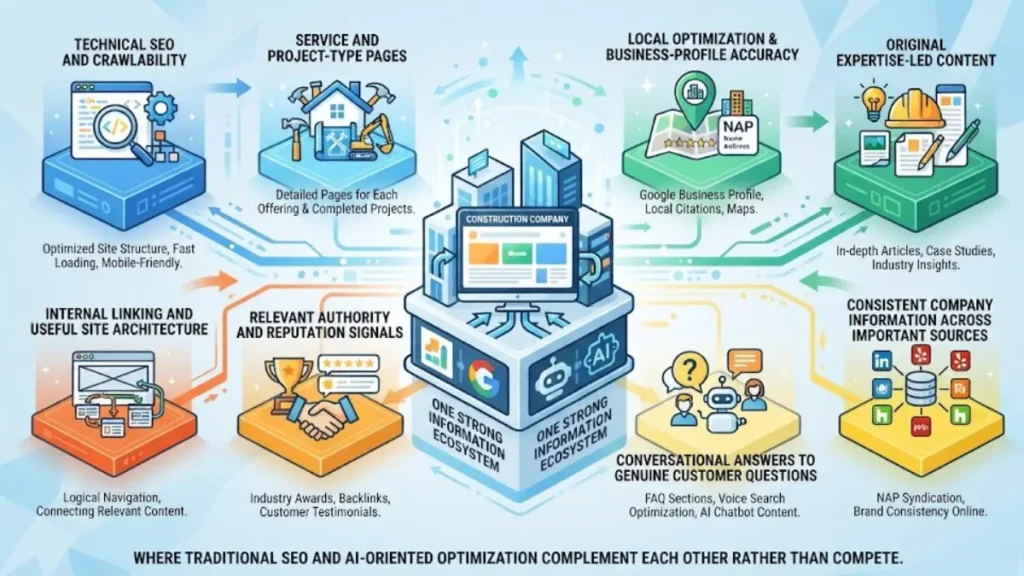
A better approach is to build one strong information ecosystem that supports both.
That can include:
- Technical SEO and crawlability
- Service and project-type pages
- Local optimization and business-profile accuracy
- Original expertise-led content
- Internal linking and useful site architecture
- Relevant authority and reputation signals
- Conversational answers to genuine customer questions
- Consistent company information across important sources
This is where traditional SEO and AI-oriented optimization complement each other rather than compete.
Which Approach Is Right for a Denver Construction Company?
For most construction companies, choosing traditional SEO or AI SEO is the wrong framing.
Traditional SEO provides the infrastructure and search foundation. AI-oriented optimization can extend that foundation into newer search environments where people ask longer, more conversational questions.
A builder starting with weak technical SEO, unclear service pages, or poor local information should address those fundamentals first.
A company with an established search presence can then look more closely at how its expertise is represented across conversational search, AI-generated answers, third-party sources, reviews, and other reputation signals.
The priority should always be the same: make the business easier for potential customers and the systems helping them find information to understand.