A business can appear in nearby searches, attract website visitors and still struggle to generate enquiries. When that happens, the problem is not always a lack of visibility. Often, something between the search result and the customer’s decision is preventing that visibility from becoming business.
A person looking for a nearby service is usually trying to make a decision. They may need help with a specific problem, compare several providers or look for evidence that a company can be trusted. If the search result, website or business profile does not answer those needs quickly, the opportunity can disappear.
This is why effective local SEO needs to be considered as a complete customer journey. Being discovered is important, but relevance, trust and a simple path to contact determine whether that discovery becomes a genuine lead.
The Search Result May Not Match What Customers Need
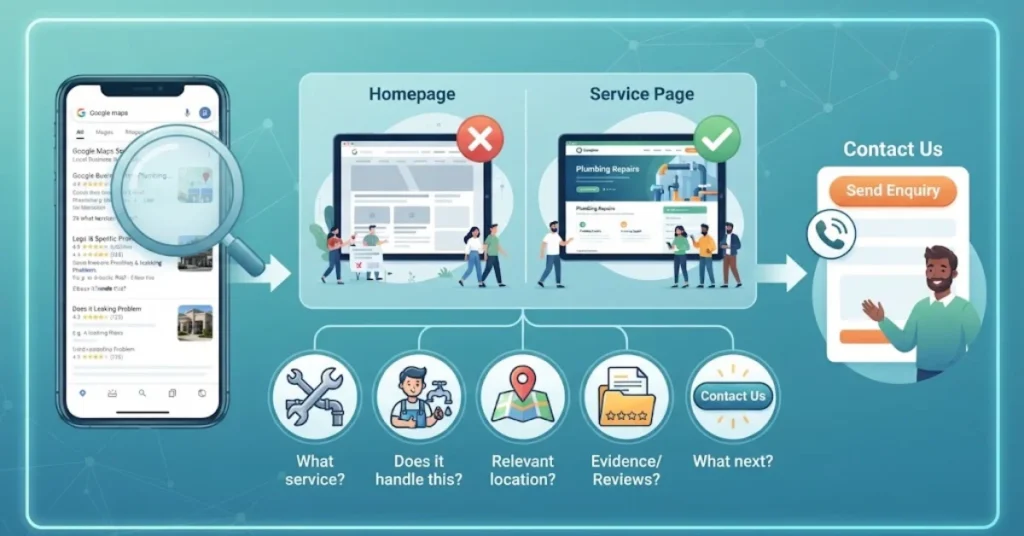
One of the first things to examine is the connection between the search and the page or profile the customer reaches.
Someone searching for a specific service does not necessarily want to land on a general homepage filled with broad company information. They want confirmation that the business provides the service they need and understands the problem behind their search.
This becomes particularly important when several competitors appear nearby. Customers can quickly move between websites and profiles, comparing services, experience, reviews, locations and contact options.
A useful local search presence should make the answer obvious:
- What service is available?
- Does the business handle this particular problem?
- Is the company relevant to the customer’s location?
- What evidence supports the business’s claims?
- What should the customer do next?
If those answers are difficult to find, a ranking may generate a visit without generating an enquiry. This is where well-planned local SEO services can help connect search visibility with a clearer and more useful customer journey.
Why More Visibility Does Not Always Mean More Customers
The idea that “more traffic equals more leads” can make local marketing difficult to evaluate.
Not every search has the same commercial intent. One person may be researching a problem, while another may be ready to call a provider. A third may simply be comparing prices or checking whether a service is available locally.
This is also why the question: is local SEO dead? is usually the wrong starting point. Local search remains valuable, but businesses need to understand the quality and intent of the searches they are attracting.
A business receiving visits from loosely related searches may see activity without seeing meaningful enquiries. Conversely, a smaller amount of highly relevant traffic can be much more commercially valuable.
The goal should therefore be to attract the right people and give them a strong reason to continue.
Trust Can Be the Missing Step Before Contact
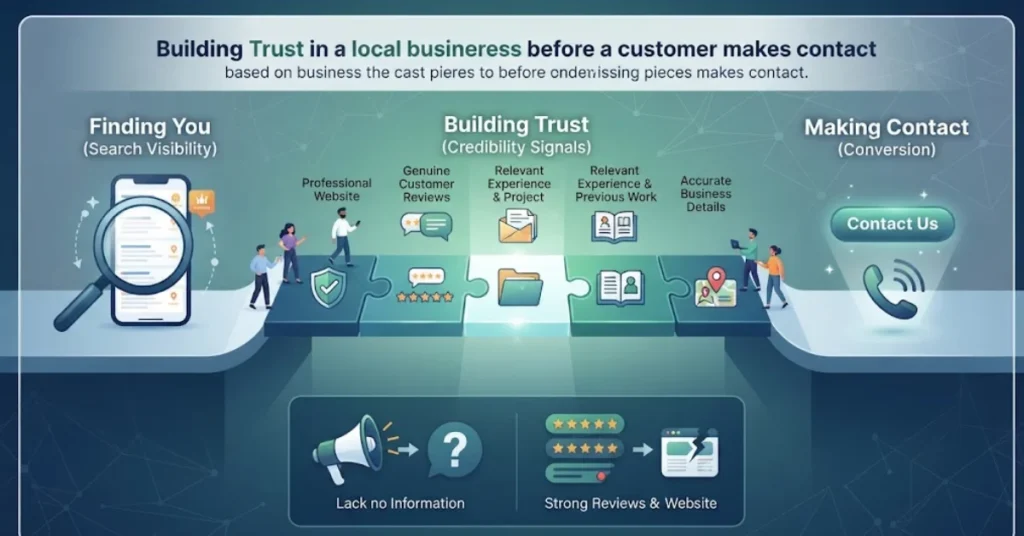
Finding a company is not the same as trusting it.
When customers compare local providers, they often look for signals that reduce uncertainty. A professional website helps, but so can genuine customer reviews, relevant experience, clear service information, examples of previous work and accurate business details.
A business should avoid making claims that cannot be supported. Instead, its online presence should demonstrate what it does and why a potential customer can reasonably consider it.
This is where local SEO services should go beyond technical optimization. The strongest work considers how search visibility interacts with credibility.
For example, a company may have excellent visibility for a service but lack useful information about its process. Another may have strong reviews but send visitors to a poorly structured page. Improving the missing piece can be more valuable than simply adding another keyword to the website.
Your Website Has to Continue the Search Journey
A customer who clicks from a local result should immediately recognize that they have reached the right place.
If the page is slow, difficult to navigate, unclear about the service or missing an obvious contact option, the customer may leave and return to the search results.
A conversion-friendly local page does not need to be complicated. It should communicate the service clearly, establish relevance, provide useful supporting information and make the next step straightforward.
Mobile usability is especially important because local searches frequently happen when people are looking for a provider in the moment.
For local SEO for small business, this can be a practical advantage. Instead of trying to create enormous amounts of content, a business can improve the pages that already have the greatest potential to attract qualified customers.
The focus should be on answering real customer questions rather than producing pages simply because a keyword appears to have search volume.
What a Professional Local SEO Campaign Should Diagnose
A good campaign begins with diagnosis rather than a fixed list of tasks.
A local SEO company or local SEO agency should first establish where the business is currently visible, which searches are relevant, what customers see when they arrive and where potential enquiries may be getting lost.
Depending on the business, the work may involve improving service pages, strengthening local relevance, correcting technical problems, optimizing a business profile, developing useful content or improving conversion paths.
A local SEO specialist should also distinguish between problems that affect visibility and problems that affect conversion. More traffic will not solve a website that fails to explain the service. Likewise, a better landing page cannot compensate for a business being almost invisible for its most valuable searches.
This distinction makes reporting more meaningful. Instead of focusing only on positions, businesses can evaluate whether the overall search journey is becoming stronger.
How to Choose an SEO Partner Without Losing Control
Choosing an SEO provider is a commercial decision, not simply a marketing purchase.
Businesses should understand what they are paying for, what accounts and assets they retain access to, how results will be reported and how recommendations will be connected to their objectives.
A common question is: does my SEO company own my leads? The practical answer should be clear from the start: leads generated for your business are part of your business, and your agreement should clearly establish ownership and access to the relevant website, advertising, analytics and business-profile assets.
When comparing a seo service agency, ask how the provider identifies opportunities, measures progress and communicates problems. Good local SEO consulting should make the business owner more informed, not more dependent on unexplained reports.
Look for:
- Transparent reporting and account access.
- Clear explanations for recommended work.
- Strategies based on the actual business and customer journey.
- Measurable commercial objectives.
- No unrealistic guarantees about rankings or traffic.
This matters whether a company is hiring a local provider or evaluating a local SEO marketing company for a wider campaign.
Turning Nearby Searches Into Better Business Opportunities
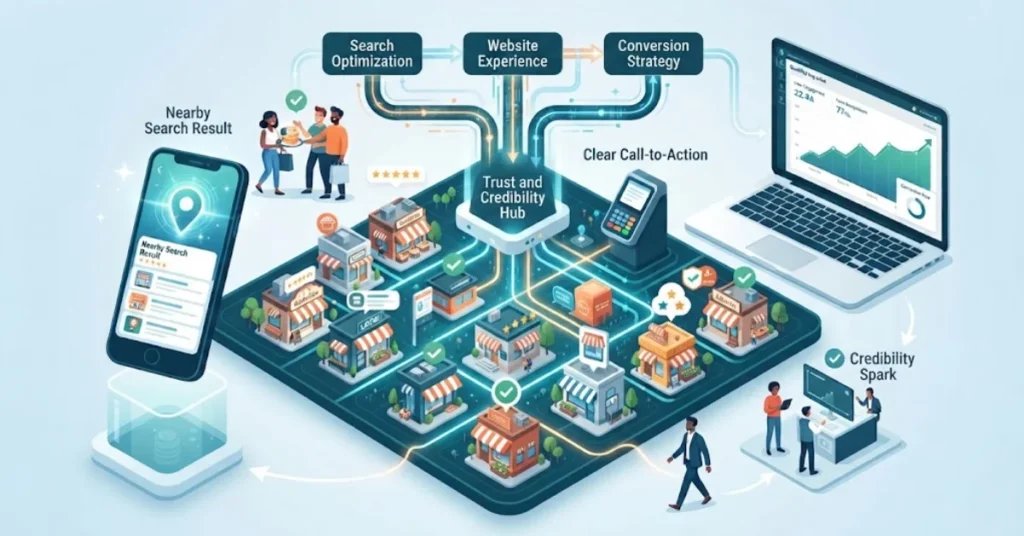
The difference between visibility and lead generation often comes down to what happens after discovery.
A business should make its services easy to understand, demonstrate genuine credibility, maintain accurate local information and provide a straightforward way for qualified visitors to enquire.
That requires coordination between search optimization, website experience and conversion strategy. Local business SEO services are most useful when these areas work together rather than being treated as separate tasks.
Content also has a role, but it should solve genuine customer problems. A useful local SEO blog can answer questions that potential customers ask before contacting a provider, while service pages can address people who are further along in the buying process.
For businesses operating in local SEO Virginia markets or other competitive areas, the same principle applies: local relevance needs to be supported by useful information and a credible customer experience.
A strong campaign does not need to promise that every visitor will become a customer. Its purpose is to make the business more relevant to valuable searches and remove unnecessary barriers for people who are already looking for its services.