A local search rarely starts with a business wanting to rank. It starts with a person who needs something.
They may want an answer, be comparing providers, look for a specific company, or be ready to contact someone. Those situations can produce completely different searches, even when the keywords appear closely related.
That is why successful local SEO requires more than collecting phrases with search volume. The real opportunity is understanding the reason behind each query and building a page that satisfies that need.
This guide explains the 4 search intent categories, shows how they apply to local businesses, and explains how to turn intent research into a practical content and conversion strategy.
What Is Search Intent and Why Does It Matter?
Search intent is the purpose behind a query the outcome a person hopes to achieve when they search.
Consider three searches:
- how does local SEO work? is primarily educational.
- best local SEO agency for small business: suggests that the searcher is evaluating options.
- Rank Locale contact: indicates that the person already knows the destination they want.
- hire local SEO expert: signals a much stronger desire to take action.
The words are different because the needs are different.
This is the foundation of user intent SEO. Instead of asking only, Which keyword should this page target?, ask, What does someone expect to accomplish after searching this?
That change affects the page format, depth of information, internal links, calls to action, and even whether a blog post is appropriate in the first place.
It also helps prevent a common problem: creating several pages around similar keywords that provide almost the same information. A page should exist because it serves a distinct purpose, not simply because another keyword variation was discovered.
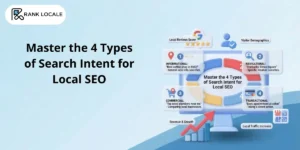
The 4 Types of Search Intent in Local SEO
The four widely used categories are informational, commercial, navigational, and transactional. They are not rigid rules; a query can contain more than one motivation. The useful part is identifying the dominant need and designing the experience around it.
1. Informational: I Need to Understand Something
Informational searches happen when people are trying to learn, investigate, or solve a problem.
A business owner might search:
- what is local SEO
- how to improve local search visibility
- how much does local SEO cost
- why is my business not showing on Google Maps
The searcher is not necessarily ready to hire anyone. They first want a useful explanation.
A detailed guide, tutorial, glossary, FAQ, or problem-solving article is usually a natural format for this stage. The strongest content answers the main question quickly, then adds context, examples, practical steps, and relevant next actions.
For example, an article explaining why a business has weak local visibility can introduce the factors involved and then connect readers to a relevant service page. The commercial element should support the answer rather than interrupt it.
This is where expertise becomes valuable. Explain the subject accurately, acknowledge important limitations, and use examples that reflect genuine knowledge of the problem.
2. Commercial: Which Option Should I Choose?
Commercial searches occur when the person understands the problem and is investigating potential solutions.
Queries might include local SEO expert, local SEO agency, SEO company for small business, or local SEO services near me.
The searcher may compare experience, services, pricing, reviews, processes, industries, reporting, and expected outcomes.
A page targeting this audience should therefore do more than say that a company provides SEO. It should help the visitor evaluate whether the service is appropriate.
A strong commercial page can explain what is included, who the service is designed for, how the process works, what information the client receives, and what questions should be asked before hiring a provider.
This is also where local SEO cost searches need careful treatment. Instead of presenting an arbitrary price as universal, explain the factors that influence scope and investment, such as the number of locations, competition, technical condition of the site, content requirements, and ongoing optimization.
The purpose is to reduce uncertainty so the reader can make an informed decision.
3. Navigational: Take Me to the Place I Mean
Navigational intent is different because the searcher already has a destination in mind.
They might search for a company name, a branded service, a contact page, or a specific location.
For a business, this makes accurate and consistent information important. Your website should make it straightforward to find essential details such as the business identity, contact information, location information, services, and relevant destination pages.
Google’s documentation explains that structured data can help Google understand information about organizations and local businesses, including details such as names, addresses, telephone numbers, and other business information.
The strategic lesson is simple: when someone already knows where they want to go, don’t make them work to find it.
4. Transactional: I’m Ready to Do Something
Transactional searches show a stronger intention to act.
Examples include hire local SEO expert, local SEO consultation, SEO agency contact, or request local SEO services.
At this point, a lengthy educational article may not be the best destination. The visitor needs confidence, clarity, and an easy route to the next step.
A service page should explain the problem being addressed, the service provided, the expected process, relevant experience, and how to make contact. Strong evidence can include genuine case studies, credentials, transparent methodology, testimonials where appropriate, and clearly presented business information.
The objective is not to pressure the visitor. It is to remove unnecessary uncertainty between their search and the action they are considering.
How to Turn Search Intent Into the Right Page
Knowing the category is only the first step. The next question is what page should actually appear for the query. Start with the search results themselves.
If Google predominantly shows guides and educational articles, that is a useful signal that searchers want information. If the results contain comparison pages, service providers, or review-style content, the query may have a stronger evaluation component. If branded pages dominate, the search may be navigational. If service pages and strong calls to action dominate, action-oriented intent may be more important.
This is the practical side of an SEO search intent strategy: use the results as evidence rather than assuming what the keyword means from its wording alone.
Then give each important query a clear destination.
An educational question can lead to an in-depth article. A comparison query can lead to a service evaluation page. A branded query should lead to the relevant business destination. A high-action query should land on a focused service or contact page.
That separation creates a cleaner website architecture and reduces unnecessary content overlap.
Build Local Content Around Real Customer Problems
The strongest local strategy connects search behavior with real business problems.
Instead of producing ten pages because ten keyword variations exist, identify the questions customers repeatedly ask before they contact you.
A local business may need content addressing visibility problems, service comparisons, pricing considerations, location-specific questions, common mistakes, or decisions customers face before purchasing. From there, connect related pages logically.
An informational article can introduce a problem. A deeper guide can explain possible solutions. A service page can explain how the business helps. A contact page can provide the final action.
This structure gives visitors a natural path without forcing every page to sell.
It also creates opportunities for useful internal links. An article about improving local visibility might naturally link to a relevant service, while a service page can point back to educational material that answers common pre-purchase questions.
The result is a website where every page has a reason to exist.
Where AI Fits Into Modern Local SEO
AI can make research and analysis faster, but it should not become a substitute for understanding customers.
A modern local SEO AI workflow can help organize large keyword sets, identify related questions, cluster topics, compare SERP patterns, and find gaps between existing pages. Human review is still needed to decide whether those findings actually represent useful opportunities.
For example, AI might identify several variations of a query. That does not automatically mean each variation deserves its own page. If the searches represent the same need and the existing results satisfy them with the same type of content, creating multiple near-identical pages may add little value.
Use technology to discover patterns; use experience and judgment to decide what deserves publication.
Google’s Search documentation emphasizes helping its systems understand site content and provides guidance around structured data and search appearance.
The goal should therefore remain human-centered: create something genuinely useful for the person behind the query.
How to Measure Whether Your Intent Strategy Is Working
Intent optimization should not end when an article is published.
Look at what happens after publication. Search Console can show which queries generate impressions and clicks, while analytics can help reveal what visitors do after arriving.
The important question is not simply whether a page receives traffic. Ask whether the traffic matches the page’s purpose.
An informational article should attract people looking for the problem it addresses. A commercial page should attract people evaluating solutions. A service page should bring visitors closer to contacting the business.
Review the page when the data suggests a mismatch. If a page receives impressions for searches that it does not answer well, its content or targeting may need refinement. If users reach a service page but have no clear next step, the conversion experience may need improvement.
Search behavior also changes. Google’s documentation notes that after publishing or updating structured data, Google needs time to crawl and re-index pages; therefore, performance should be evaluated over an appropriate period rather than immediately after publication.
Frequently Asked Questions
The four commonly used categories are informational, commercial, navigational, and transactional. They represent different reasons people use search, from learning and researching to finding a destination or taking action.
Local search intent is the local purpose behind a query. It can involve finding information about a service, comparing nearby providers, locating a specific business, or taking an action with a local company.
Search the query and examine the results Google currently displays. Look at the dominant page formats, local results, business listings, questions, and calls to action. These signals provide practical evidence about what the searcher is trying to accomplish.
Yes. A search can contain mixed motivations. Someone searching for a local SEO expert may be researching providers while also considering hiring one. Focus on the dominant purpose while making the page useful for closely related needs.
Yes. It helps determine which keywords belong on educational content, service pages, comparison content, location pages, or conversion-focused destinations. This can make a website easier for both visitors and search engines to understand.
Conclusion
Good local SEO starts before the keyword is added to a page. It starts with understanding the person behind the search.
Informational users need useful answers. Commercial searchers need enough evidence to compare their options. Navigational users need a clear destination. Transactional visitors need confidence and an uncomplicated next step.
Once those differences are understood, content becomes easier to plan. Instead of producing pages that compete with one another, you can build a website where each important page serves a specific search need.
For businesses that want to turn local visibility into qualified opportunities, we provides search-focused SEO and digital marketing strategies built around customer intent, useful content, technical foundations, and measurable business goals.
If your website is receiving impressions but attracting the wrong searches or visitors are finding your pages without taking the next step contact us at +1 302-558-4901 to discuss a more focused local search strategy.