Your business may have a website, a verified Google Business Profile, good reviews, and years of experience, yet still be difficult to find when someone searches for your services nearby.
This situation occurs more frequently than many business owners realize.
While a business may appear when its name is specifically searched for, it remains far less visible in searches that do not mention the brand such as electrician near me, dentist in Denver, roofer in the area, or other service-related search terms. This distinction is significant, as people who do not yet know your business often represent the very target audience you most want to reach.
The answer is rarely as simple as adding more keywords.
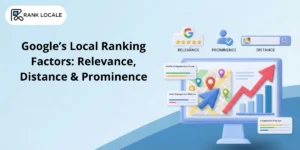
Google says local results are primarily influenced by relevance, distance, and prominence. Relevance concerns how well a business matches the search, distance considers the searcher’s location, and prominence reflects how well-known or established the business is based on signals Google can identify.
So when local visibility is weak, the better question is not “How do I add more SEO?” It is:
What information or signal is missing, unclear, weak, or inconsistent?
First, Find the Actual Visibility Problem
Before changing your website or Business Profile, determine exactly where the business is losing visibility.
There are several very different situations:
What you see | What it can indicate | What to investigate |
Business name ranks, service searches do not | Weak non-branded relevance | Services, categories, website content |
Website ranks but Maps visibility is weak | Local profile or prominence issue | Profile, reviews, local signals |
Maps visibility changes by area | Distance and local competition | Search locations and service coverage |
Some services appear, others do not | Uneven topical relevance | Service pages and profile categories |
Pages receive impressions but few clicks | Search-intent or SERP issue | Titles, descriptions, page relevance |
Important pages are not indexed | Technical problem | Crawling, indexing, internal links |
Do not judge local performance from one search made on one device.
Local results can change according to the searcher’s location and the wording of the query. A business may therefore appear prominently from one area and much lower from another.
Start by testing several important service searches and compare what happens in both Google Search and Maps.
This gives you a baseline before you begin making changes.
The Business Profile May Not Match What Customers Are Searching For
Your Google Business Profile is one of the first places to investigate.
Google recommends keeping business information complete and accurate, including details such as the business category, address where applicable, hours, and other relevant attributes.
Look at the profile from a customer’s perspective.
Does it immediately communicate:
- What the business actually does?
- Which primary service it provides?
- What other legitimate services are available?
- Where customers can find or contact the business?
- When the business is available?
- What makes the business relevant to the search?
The objective is not to place every possible keyword in the profile.
It is to give Google and potential customers accurate information that represents the real business.
Google also explains that information shown in Business Profiles can come from multiple sources, including the business website, third parties, users, and other publicly available information.
That makes accuracy across the broader web important as well.
Your Website and Profile Need to Tell the Same Story
A common weakness is a mismatch between a Business Profile and the website.
Imagine a profile describing a company as a roofing contractor while the website’s homepage focuses mainly on general home improvement. Or the profile lists services that have little supporting information on the website.
That creates an unclear picture.
Your website should provide deeper information about the services represented in your local listing.
A strong service page should explain what the service is, who needs it, the problems it addresses, what the process involves, and why the company is qualified to provide it.
This is where Local SEO becomes broader than optimizing a single listing.
The website, profile, service information, reviews, and other legitimate business references should collectively describe the same company.
Don’t Try to Rank Every Service With One Page
Another common problem is asking one homepage to rank for everything.
A company might offer six or ten major services but describe all of them in a few short paragraphs.
That makes it difficult to provide a useful answer for someone searching for one specific service.
Create dedicated pages when a service is substantial enough to deserve one.
For example, an HVAC company might need separate resources for installation, repair, maintenance, and emergency service. A law firm may need distinct pages for meaningful practice areas.
The important point is not the number of pages.
The page should exist because the customer has a distinct need that deserves a distinct answer.
This is one of the practical foundations of Local Business Marketing because the same page that helps search visibility can also help a potential customer decide whether to contact the company.
Location Should Add Meaning, Not Keyword Repetition
Adding a city name repeatedly does not automatically create stronger local relevance.
Instead, use geographic information where it genuinely helps.
A location-focused page can explain the areas served, relevant services, local project experience, directions where appropriate, or questions that customers in that market commonly ask.
This produces more useful content than writing the same paragraph repeatedly and replacing one city name with another.
The same principle applies to Local SEO Tips: local content should be created for people first.
If a location page could be moved from one city to another simply by replacing the city name, it probably needs more substance.
Reviews Should Reflect Real Customer Experience
Reviews are important to local businesses because they help people evaluate whether a company is trustworthy.
Google says reviews and positive ratings can contribute to local ranking through prominence.
But that does not mean businesses should chase reviews at any cost.
The sustainable approach is to encourage genuine customers to leave honest feedback and respond professionally.
Pay attention to what customers naturally mention.
If customers repeatedly describe a particular service, experience, or strength, that language can help you understand what the market values.
Never manufacture reviews or create artificial customer experiences. A short-term attempt to manipulate reputation can damage trust much more than it helps visibility.
Check Your Business Information Across the Web
Your local presence extends beyond Google.
Business information may appear on directories, professional associations, social profiles, review platforms, industry websites, and other sources.
Google says it uses information from multiple sources when building and displaying Business Profile information.
That means it is worth checking the core details across important platforms.
Focus on accuracy rather than quantity.
Your legitimate business name, phone number, website, address where applicable, and major business details should not contradict one another.
You do not need hundreds of low-quality listings.
A smaller set of relevant, trustworthy references can be more useful than creating profiles everywhere simply for the sake of having more citations.
Fix Technical Problems Before Publishing More Content
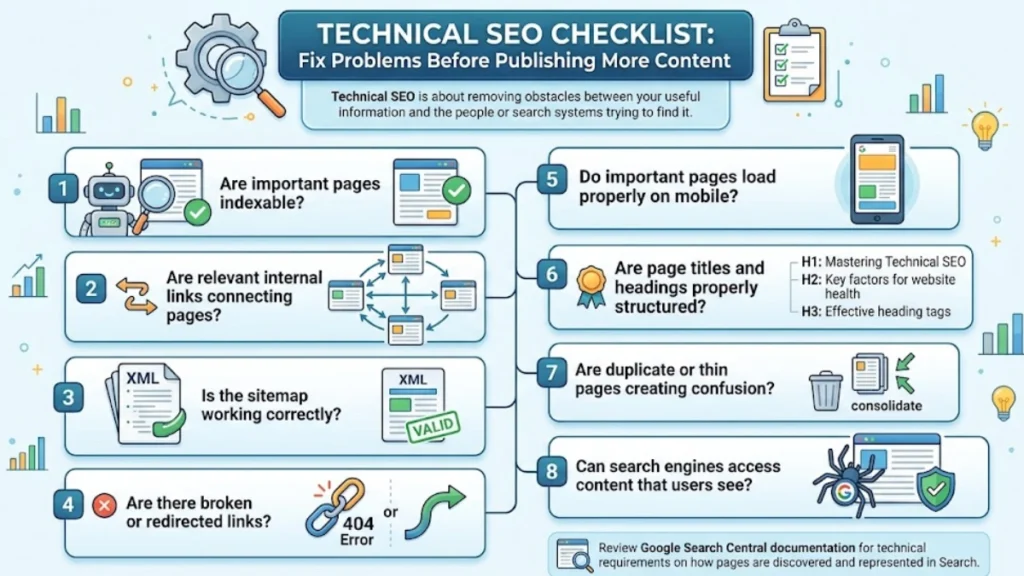
Sometimes the problem is not local relevance at all.
The website may have valuable information that search engines cannot efficiently discover or index.
Review the technical basics:
- Are important pages indexable?
- Are internal links connecting related pages?
- Is the sitemap working correctly?
- Are there broken or redirected links?
- Do important pages load properly on mobile?
- Are page titles and headings descriptive?
- Are duplicate or thin pages creating unnecessary confusion?
- Can search engines access the content that users can see?
Google Search Central provides technical requirements and documentation for how pages can be discovered and represented in Search.
Technical SEO is not about adding complicated code everywhere.
It is about removing obstacles between useful information and the people or search systems trying to find it.
Build Authority From Real Business Experience
Ranking locally is not just a technical exercise.
A company that has genuine experience should make that experience visible.
Instead of repeatedly describing the business as “trusted,” “leading,” or “top rated local,” demonstrate what the company actually knows.
Useful evidence might include genuine project examples, detailed case studies, staff expertise, professional credentials where relevant, original photographs, customer questions, practical guides, and explanations based on real work.
This is where SEO Problems often become content problems.
If competitors provide clearer evidence of experience while your website makes broad claims, a potential customer has less information to evaluate.
Good content does not need to sound impressive.
It needs to be specific enough to be useful.
Build Content Around the Customer’s Next Question
A local business blog should not be a collection of articles created only because there is a keyword to target.
Think about what a potential customer asks before contacting you.
Someone researching a service might ask what it costs, what is involved, how long it takes, whether they need a specialist, what warning signs to look for, or how to compare providers.
Those questions can become useful resources.
For example:
Before hiring: What should customers check before choosing a provider?
During research: What does the service actually involve?
During comparison: What is the difference between two common approaches?
Before contacting: What information should a customer prepare?
This supports a broader SEO Strategy because your content serves different stages of the buying journey rather than targeting one keyword repeatedly.
Understand What Google Maps SEO Can and Cannot Do
Google Maps SEO can improve how a business is represented in local search, but it cannot override every factor.
Distance is particularly important because a searcher’s location affects which businesses are considered nearby. Google also evaluates relevance and prominence.
That means a business should not expect optimization to make it appear equally prominently for every search across a large geographic area.
Instead, focus on the market the business genuinely serves.
Make the profile accurate. Strengthen relevant service information. Build a useful website. Earn genuine customer feedback. Maintain accurate business information. Demonstrate real expertise.
These are controllable parts of a broader local strategy.
When Your Local Ranking Needs a Deeper Audit
If you have already completed the basic work and visibility remains weak, stop making random changes.
A proper audit should compare the business against the actual search environment.
Look at the queries that matter commercially, the competitors appearing for them, the pages Google is displaying, the categories and services represented, the quality of local signals, and the technical condition of the website.
The purpose is not to copy competitors.
It is to identify what your customers need that your current online presence does not explain clearly.
For some businesses, the issue may be relevance. For others, it may be website quality, prominence, technical accessibility, competition, or simply distance from the searcher.
That diagnosis determines the next step.
A Practical Local SEO Recovery Plan
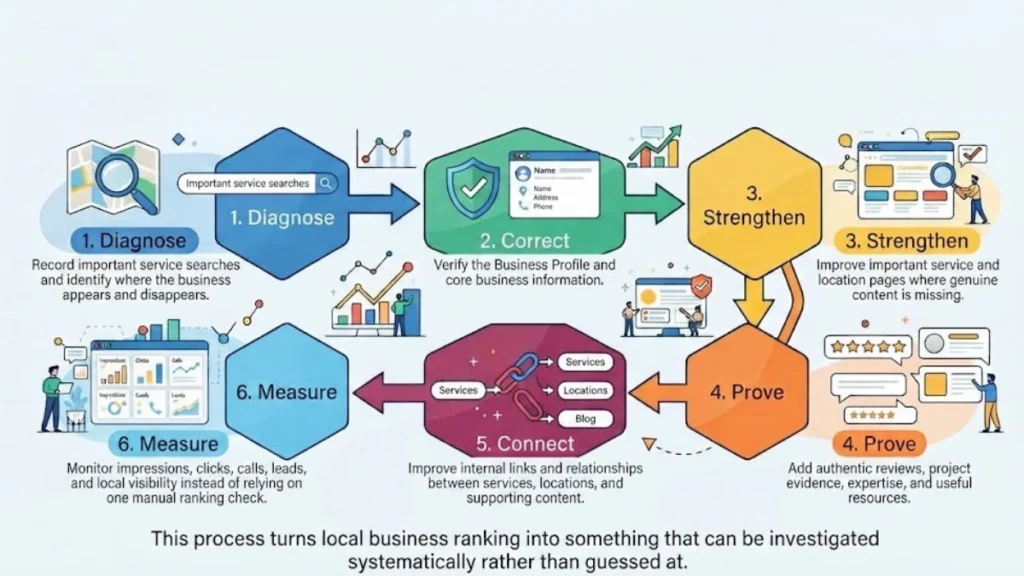
If you want to improve visibility without wasting time, work through the process in order.
Step 1 = Diagnose: Record important service searches and identify where the business appears and disappears.
Step 2 = Correct: Verify the Business Profile and core business information.
Step 3 = Strengthen: Improve important service and location pages where genuine content is missing.
Step 4 = Prove: Add authentic reviews, project evidence, expertise, and useful resources.
Step 5 = Connect: Improve internal links and relationships between services, locations, and supporting content.
Step 6 = Measure: Monitor impressions, clicks, calls, leads, and local visibility instead of relying on one manual ranking check.
This process turns local business ranking into something that can be investigated systematically rather than guessed at.
What Results Should You Actually Measure?
A better local SEO measurement system looks beyond a single ranking number.
Track whether your important pages are indexed, whether relevant queries generate impressions, whether organic visitors reach commercial pages, and whether those visitors become meaningful inquiries.
For local businesses, conversions might include calls, quote requests, bookings, direction requests, or completed contact forms.
Also remember that Google does not offer a method to pay for a better organic local ranking.
Anyone promising a guaranteed Maps position or guaranteed traffic within a few days is offering certainty that the search system itself does not provide.
SEO should be judged by measurable improvements over time.