A local business social media profile should do more than sit online with a logo, phone number, and occasional promotion. When a potential customer discovers your business, they want quick evidence that you are active, legitimate, experienced, and able to solve their problem.
That makes social media less about “posting every day” and more about showing the right information at the right stage of the buying journey.
A useful page can show completed work, answer customer questions, introduce the people behind the business, explain services, and give prospects an easy reason to contact you.
The challenge is knowing what to post without repeating the same sales message.
This guide shows how to build a useful profile, where to find content ideas, and nine practical social media post examples that local businesses can adapt without making their feeds feel repetitive.
Start With the Customer, Not the Content Calendar
Before creating a post, think about what someone needs to know before choosing your business.
A potential customer may be wondering whether you provide the service they need, whether you work in their area, what the process looks like, whether your work is reliable, or what previous customers think about you.
Your social profile should gradually answer those questions.
That means content should have a job. One post might demonstrate expertise, another might provide proof of your work, while another might encourage someone who is already interested to request an estimate.
This approach is more useful than publishing random updates simply to keep the account active.
Turn Your Profile Into a Local Trust Page
Your local business social media page should immediately tell visitors who you are and what you do.
Use a recognizable business name, consistent branding, a clear description of your service, relevant contact details, and a website link where available.
Your profile should also make your service area understandable. A local customer should not have to search through several posts to determine whether your company serves their location.
Keep the description natural. Adding every possible keyword can make a profile look artificial and does not make the customer experience better.
The content underneath the profile then provides the proof.
Create Content From Real Business Activity
One of the easiest ways to maintain an active profile is to stop treating content creation as a separate task.
Your normal business activity already produces material.
A completed project can become a post. A common customer question can become an educational update. A team member can be introduced. A seasonal service can become a reminder. A customer review can become social proof.
This approach also makes content more authentic because you are showing what the business actually does rather than creating generic marketing messages.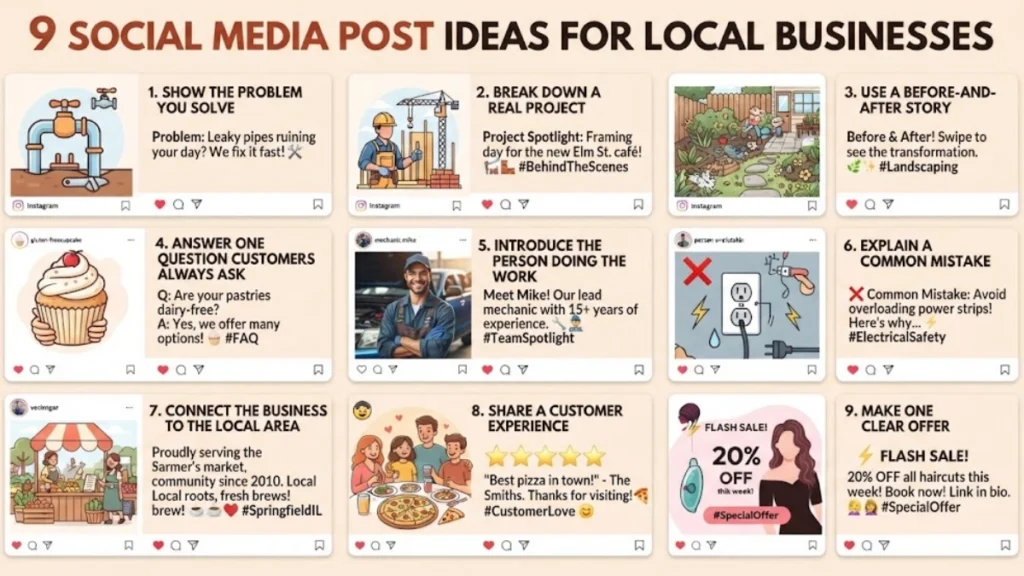
9 Social Media Post Examples That Local Businesses Can Use
The following ideas are designed to cover different customer questions instead of giving you nine variations of the same promotional post.
1. Show the Problem You Solve
Start with a problem your customers regularly experience.
Explain what the problem looks like, why it can matter, and when professional help may be appropriate.
For example, a concrete contractor could explain what certain surface problems may indicate and what a property owner should consider before deciding between repair and replacement.
This type of post attracts people who are researching a problem rather than immediately looking for a sales pitch.
2. Break Down a Real Project
Take one completed job and explain the work behind it.
Show the starting condition, the main work performed, and the finished result. If appropriate, explain a decision the team made during the project.
A project breakdown demonstrates experience without having to repeatedly say that your company is experienced.
It also gives potential customers a better idea of what working with your business actually looks like.
3. Use a Before-and-After Story
Before-and-after images can communicate results quickly, but the caption should provide context.
Explain what was changed and why the work was necessary.
Rather than simply writing Before and after, tell the customer what they are looking at. This turns an image into a useful piece of content.
These are particularly effective social media content examples for businesses where the finished result is visually obvious.
4. Answer One Question Customers Always Ask
Your inbox, phone calls, estimates, and conversations with customers are a source of content ideas.
Choose one question and answer it clearly.
It could involve preparation, timing, maintenance, pricing factors, materials, service expectations, or something customers frequently misunderstand.
This is one of the easiest ways to create social media post ideas that are genuinely relevant because they come directly from customer intent.
5. Introduce the Person Doing the Work
Local businesses have an advantage that large companies often struggle to create: personal connection.
Introduce a team member and explain their role. Show what they work on, what they specialize in, or what customers can expect when interacting with them.
The purpose is not to create a formal biography. It is to make the business more familiar.
For a company where employees visit customers’ homes or properties, this can be particularly valuable.
6. Explain a Common Mistake
Create a post around something customers frequently get wrong.
For example, a contractor could explain a mistake property owners sometimes make when planning an outdoor project. A service business could explain why delaying a particular maintenance task may create additional complications.
Educational posts can demonstrate expertise without turning the entire profile into advertising.
This is where social media content ideas should focus on the customer’s problem rather than the company’s desire to promote itself.
7. Connect the Business to the Local Area
Your content does not always need to be about your services.
Share something relevant to the community, a seasonal consideration, a local event, or an issue that affects customers in your service area.
The connection should be genuine. Avoid forcing a location name into every caption simply to appear local.
A business becomes more recognizable when people see that it understands the area and the customers it serves.
8. Share a Customer Experience
Customer feedback can provide useful social proof when shared with permission.
Instead of posting a review without context, explain what the customer hired you to do and what part of the experience they appreciated.
This helps prospective customers understand the type of service they can expect.
Reviews are especially useful when someone is comparing several local providers and wants evidence beyond what a company says about itself.
9. Make One Clear Offer
Not every post should ask for a sale, but your content strategy should occasionally give interested customers a clear next step.
That could be requesting an estimate, scheduling a consultation, calling the business, visiting the website, or sending a message.
Keep the offer specific and relevant to the audience.
A direct-response post works better when previous content has already established expertise and credibility.
Build a Content Mix Instead of Repeating One Post Type
The biggest problem with many local profiles is not a lack of ideas. It is repetition.
If every post says We provide quality service contact us today, followers quickly stop paying attention.
Instead, rotate between different purposes. Educational posts answer questions. Project content demonstrates capability. Customer experiences provide proof. Team content makes the company more personal. Offers create opportunities to take action.
This gives your best social media posts a clear role within the overall customer journey.
When Are the Best Times and Days to Post?
There is no single posting schedule that works equally well for every local business.
The best times and days to post on social media depend on the platform, audience, industry, and when your customers are actually active.
Rather than following a generic timetable forever, test different publishing periods and review your account’s analytics.
Pay attention to meaningful actions such as profile visits, website clicks, messages, calls, shares, saves, and inquiries.
A smaller number of useful posts at times when your audience is paying attention can be more valuable than publishing constantly.
Measure Business Results, Not Just Likes

Social media metrics can be useful, but follower counts and likes do not tell the entire story.
A local business should connect social activity to actions that have commercial value.
Ask:
- Are people visiting the website?
- Are customers sending messages?
- Are profile visitors calling?
- Are posts generating quote or consultation requests?
- Which topics receive meaningful saves or shares?
- Which content appears to bring people closer to contacting the business?
The answers can help you decide which content deserves more attention.
A post with fewer likes but several qualified inquiries may be far more valuable than a post that receives hundreds of casual reactions.
How Social Media Fits Into Local SEO
Social media should be viewed as one part of a wider local marketing system.
Your website helps explain your services in depth. Your Google Business Profile helps customers discover and evaluate the business in local search. Social profiles can add another layer of visibility, proof, and brand familiarity.
For example, a business investing in concrete contractor SEO can use social content to demonstrate completed projects, answer questions about concrete services, and show the quality of its work.
Likewise, businesses interested in lead generation for concrete contractors can use useful project-based content to support the wider journey from discovery to inquiry.
This is different from treating social media as a replacement for search optimization. A stronger strategy connects the channels rather than expecting one platform to do everything.
When Should You Hire a Local SEO Expert?
Social media can strengthen your online presence, but it may not solve every visibility problem.
If your website is difficult to find in local searches, your business listings need improvement, or qualified customers are not reaching your site, a broader SEO strategy may be necessary.
When looking to hire a local SEO expert, evaluate the person’s approach rather than choosing based only on a ranking promise.
A good specialist should be able to explain how they would assess your website, local search presence, business information, content, competitors, and opportunities for improvement.
If you are searching for a local SEO expert near me, proximity can be useful, but experience with businesses similar to yours is usually more important than physical distance.
For companies that need a broader strategy, working with a top local SEO expert can help connect social content with website optimization, local search visibility, and lead generation.
When Social Media and SEO Work Together
The strongest local marketing strategies do not treat every channel as an isolated activity.
A useful social post can introduce a service. The website can explain that service in detail. Local search can help a customer discover the business when they actively need it. Reviews and project examples can then provide additional confidence.
For a service company, this creates a more complete path from awareness to inquiry.
Businesses working on concrete contractors search engine optimization, for example, can create service-focused website content while using social media to show real projects and answer questions customers ask before hiring a contractor.
The same principle can apply across home services, professional services, healthcare, automotive businesses, and other local industries.