Dofollow and nofollow links are HTML attributes that tell search engines how to treat a hyperlink.
Links connect websites across the internet. They help people discover useful resources, help search engines discover pages, and can provide context about relationships between websites.
A regular link is commonly called a dofollow link in the SEO industry. Technically, there is no special “dofollow” attribute that needs to be added to HTML. When a normal link does not contain a qualifying rel attribute such as nofollow, sponsored, or ugc, SEO professionals generally refer to it as dofollow.
A nofollow link, on the other hand, contains rel=”nofollow” and tells search engines that the publisher does not want the link treated as a normal editorial endorsement.
What Is a Dofollow Link?
A dofollow link is the common SEO term for a standard link that does not contain a qualifying link attribute such as nofollow.
For example:
<a href=”https://ranklocale.com/”>Visit Rank Locale</a>
There is no rel=”nofollow” attribute in this link, so Local SEO professionals would normally describe it as a dofollow link.
Imagine a respected industry publication writes an article about a particular service and naturally references a business as a useful resource. That editorial link can be valuable because it connects a relevant website with a relevant business.
This is why effective link building is not about finding the largest possible number of websites willing to link to you.
What Is a Nofollow Link?
A nofollow link contains the attribute:
rel=”nofollow”
For example:
<a href=”https://ranklocale.com/” rel=”nofollow”>Rank Locale</a>
This attribute tells search engines that the publisher does not want the link treated as a standard editorial endorsement.
Nofollow links are common in situations where a website wants to link to another resource without passing along the same type of endorsement associated with a normal editorial link.
They can appear in comments, forums, certain advertising placements, and other situations where a publisher does not want to vouch for the linked page in the traditional way.
For example, suppose a well-known industry website mentions your business and sends referral traffic through a nofollow link. The link may still put your brand in front of exactly the audience you want to reach.
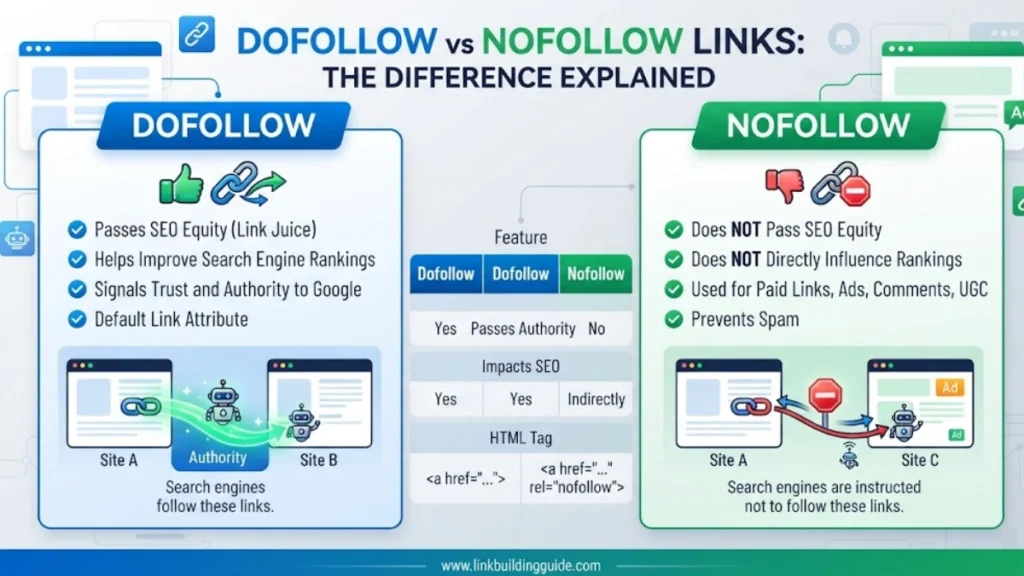
Dofollow vs. Nofollow: What Is the Difference?
The difference between dofollow and nofollow links for SEO comes down primarily to how the linking website qualifies the relationship.
A standard link can be considered as an ordinary link between two pages. A nofollow link communicates that the publisher does not want the link treated as a normal endorsement.
For a business owner, however, the practical difference is more important than the terminology.
rel=”sponsored” is used to identify links that are advertisements, sponsorships, or otherwise paid placements. rel=”ugc” is intended for links within user-generated content, such as comments or forum posts.
That is why SEO professionals look at the entire backlink profile instead of obsessing over whether every link is dofollow.
Does Your Website Need Nofollow Links?
A healthy backlink profile does not need to consist entirely of one type of link.
Think about how a real business earns online mentions. It might be discussed by an industry publication, listed in a directory, mentioned by a local organization, included in a community resource, referenced by a customer, or featured in an article.
Those links will not necessarily all have the same attributes.
Trying to force every backlink into a particular category can make link building unnecessarily artificial.
Instead, businesses should ask a more useful question:
Is this link relevant and valuable to the people who may click it?
A nofollow link from a highly relevant publication may be more useful from a marketing perspective than a dofollow link from an unrelated website that nobody visits.
A local company mentioned by a respected community website, professional organization, or industry resource can gain visibility among people who are already relevant to its market.
The value comes from the connection, not simply the HTML attribute.
How Should a Business Build Backlinks?
The best backlink opportunities usually come from giving other websites a genuine reason to reference your business.
That reason could be useful research, expert commentary, an original resource, an industry guide, a local contribution, a helpful tool, or genuinely informative content.
There are several areas worth considering:
- Create original resources, research, guides, or useful data that others can reference.
- Build relationships with relevant publications, organizations, partners, and industry communities.
- Develop content around real customer questions rather than producing pages solely to target keywords.
- Review existing backlinks regularly to understand which websites are already mentioning the business.
- Prioritize relevance and credibility over large quantities of low-quality links.
A useful resource can attract referral traffic, support brand recognition, generate conversations, and create opportunities for additional mentions.
Why Technical SEO and Website Quality Still Matter
Backlinks are only one part of SEO. That means an effective SEO strategy should consider technical SEO, content, internal linking, website architecture, page experience, search intent, and authority together.
Technical issues can include problems with indexing, redirects, duplicate URLs, broken internal links, poor site structure, mobile usability, or other aspects of website performance.
This is where technical SEO experts can be valuable. Their role is not simply to look for errors but to understand which technical issues are actually affecting the website and which improvements should be prioritized.
If you are working with a web design company, SEO should ideally be considered during the planning and development process rather than added as an afterthought.
When Should You Hire an SEO Agency?
Understanding links is useful for any business owner, but managing an entire SEO campaign requires considerably more than checking backlink attributes.
An experienced SEO agency can assess the website, competitors, content, technical structure, existing backlinks, search intent, and opportunities for improvement.
A professional SEO marketing agency should be able to connect authority building with content, technical improvements, local optimization, website performance, and business goals.
When comparing the best SEO companies, look for evidence of expertise rather than simply choosing the provider with the largest package.
Good questions include:
- How will you evaluate our existing backlink profile?
- How do you determine which link opportunities are relevant?
- What methods do you use to earn or acquire links?
- How do you handle sponsored or user-generated links?
- How does link building fit into our overall SEO plan?
- What metrics will you use to evaluate progress?
The answers can tell you considerably more about an agency’s expertise than a list of promised backlinks.